In 1990, I was ten years old. I hadn’t yet discovered Stephen King in book form. I had seen Cat’s Eye and Pet Sematary adaptations, but really was not much aware they were based on one author’s books. That changed when Stephen King’s It aired as a two-part miniseries on ABC that November. It sent my fifth grade class into a frenzy. Everyone read that book by the time the school year was over. Before I graduated high school, I had read it three times and had picked up every other King book I could get my hands on.
In 1993, Tommyknockers aired. In 1992, The Golden Years which ranks as the worst adaptation as far as the mini-series adaptations go. In 1994, The Stand changed my life. The book is still my favorite King book to this day. In 1995, the lackluster The Langoliers aired. In 1997, The Shining was adapted into a version that King fully supported and even cameoed in. He famously hated the Kubrick version because it missed the point of the book. In 1999, Storm of the Century. In 2002, Rose Red. In 2004, Kingdom Hospital and Salem’s Lot. While Bag of Bones and Under the Dome received adaptations in the 2010’s on other networks, the era of ABC adapting a King book every year or two had ended with Kingdom Hospital (Salem’s Lot aired on TNT). All of these can be traced back to the success of It changing the lives of tweens and teens by creating an obsession.
If you were lucky to have parents who made it through the 80s with jobs, then your household owned a VCR and you could record whatever you wanted. If you were really lucky, you had cable. I wasn’t that lucky, but I was able to record all the ABC King adaptations on our old VCR off of network TV. I obsessively paused the recording during commercials. Until DVD became mainstream, I had to watch those recordings on a tube television. This carried over during my college years in 1998-2002 along with watching my favorite show.
I’m off topic, I know. I’m supposed to be talking about The X-Files. I’m just setting the mood. Near the end of season five of the show, an episode aired that starred Emily Perkins who also starred in that first King adaptation for ABC. She played young Beverly Marsh who was the only girl in the Losers Club in Stephen King’s It. Her performance was filled with palpable fear and empathy. When All Souls aired eight years after It was released, I pointed at my television and yelled her name. My parents, who had gotten into the show after watching it so much with me, looked at me like I was crazy. But I knew this was another King connection during a season where King had already written another episode.
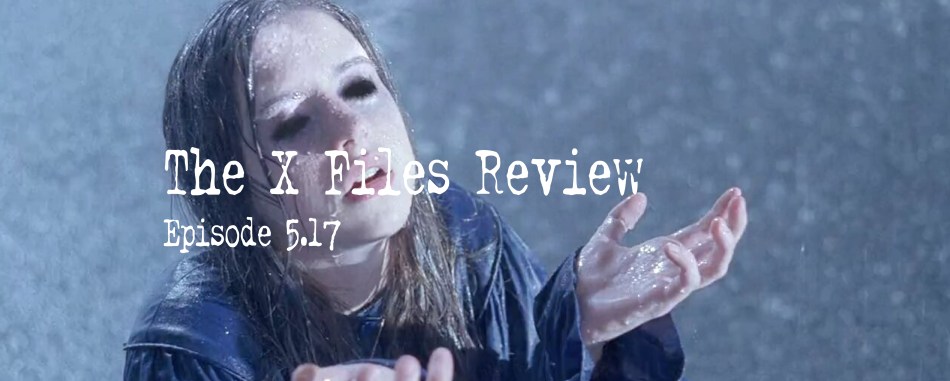
What was supposed to be a simple story about angels ending up turning an episode connected to the Christmas Carol/Emily arc about Scully’s daughter from earlier in the season. Perkins plays Dara, a disabled teenage girl who had just been baptized. She manages to get out of her wheelchair and run down the street in the middle of the night in the rain, her arms raised toward a mysterious figure. Lightning flashes and the figure is gone. Scully investigates the case and learns that Dara was adopted.
Elsewhere, a priest visits Dara’s twin Paula but is stopped by a social worker. Paula dies that night when a man enters her room. As the investigation progresses, Mulder discovers that Paula and Dara were not twins but quadruplets and that the priest wanted to adopt Paula. While he professes innocence in Paula’s death, Scully sees a vision of Emily which was jarring because the show had largely ignored her existence and death for several episodes until this.
Mulder enlists the social worker to help him find the other two girls, one of whom is homeless. She dies by the hand of the same mysterious figure that killed Paula before Mulder can get to her. The priest is there and Mulder believes he is guilty even as he says he was warding off the devil. When the social worker asks the priest where the final sister is and the priest refuses to answer, the priest bursts into flames. You know, because the social worker is really the devil.
Scully has a vision of the figure that took the other two girls and it informs her that it had fathered four nephilim – the quadruplets – and God hand sent it as an angel to bring the girls to Heaven. In reality, it was attempting to thwart the devil – the social worker – who wanted the girls for his own evil plan. When they discover that the fourth girl is at the church with the priest, it is Scully who stops the social worker when she sees that his shadow has devil horns. The angel appears to take the fourth sister, and after seeing the girl as Emily, Scully lets her go.
Scully states, rather tragically, that she thinks God is speaking to everyone and that no one is listening. This line, even now, hits home for me. I was raised Catholic. While I haven’t practiced the religion since leaving home at eighteen, I am a spiritual person. There are times, like many, when I wonder if anyone is up there listening or if anyone on Earth really listens for a response. Scully wondering this after having her faith shaken so terribly at the end of season four is more of a full circle moment for her character. Grief is a funny thing. It can cause us to do things we otherwise wouldn’t – like let a girl get taken by a supposed angel. This shows that Scully has gained back some of her faith in God, something she has wavered on over the recent seasons. It also gives her the opportunity to let go of some of her grief over Emily’s death.
The shots of the angel required special effects shots that, for the era, are really well done. Makeup was also used to make the girls look like their eyes had been burned out of their heads. Each girl had to look slightly different, so makeup and hairstyling was used to accomplish this.
I’ll admit that this isn’t the best episode, but adding in the connection to Emily made it better. Emily Perkins’ performance also made the episode watchable when it otherwise could have been terrible. Perkins would go on to star in various projects that included Ginger Snaps in 2000, a film that has a substantial cult following. Much in the way that Stephen King’s It did for me in 1990, Ginger Snaps serves as a gateway horror film, something tweens and teens discover growing up and leads to them getting into the horror genre. It has themes of teenage depression and not fitting in with society which is accentuated by getting bitten by a werewolf. It’s not perfect, but a lot of people love this film.
Before she starred in It, she starred in a made for TV survival movie that also starred Robert Conrad and Matt LeBlanc as well as X-Files alum William B. Davis. You’ll know him as the Cigarette Smoking Man. Funny how made for TV content is such a small world. Anything to Survive followed a family stranded on an island during winter. From what I remember, it was actually a great film. Too bad it fell into made for TV obscurity.
While Emily Perkins didn’t really have any other memorable roles, she did appear on Dead Like Me and Supernatural. Sometimes, have three iconic parts is all a girl needs to reach Scream Queen status. Form many, Emily Perkins certainly has since It, Ginger Snaps, and The X-Files keep her in my memory.
While season five of The X-Files aired on Sunday nights, Millennium quietly went through it’s second season. The season featured an arc where Frank’s wife discovers what his work with the cult truly is and they become estranged with his wife taking their daughter from their home to keep her safe. While Frank’s personal life fell apart, he continued investigating serial killer cases and disappearances steeped in religious undertones.
Episode 18 of Millennium, In Arcadia Ego, aired two weeks before the episode All Souls did on The X-Files. In Arcadia Ego featured guest star Missy Crider (Powder, The Beast, Frailty, Mulholland Drive) as a character who believed she had become pregnant by immaculate conception in prison. She escapes with her lesbian lover not realizing that having the baby will kill her due to a medical condition discovered during a prison medical exam. What the woman doesn’t know was that a prison employee had had sex with her while she was drugged in the infirmary.
After the shock of seeing Emily Perkins in the episode of The X-Files, it was In Arcadia Ego that I thought of as the episode progressed. The two episodes, and season two of Millennium as a whole, share themes of faith in a higher power and what happens when that faith wavers. The final episodes of Millennium’s sophomore season feature an episode about someone collecting the world’s smartest children to be part of Satan’s army and another about four demons marking Frank as the biggest enemy before the season ends with the viral outbreak kills Jack’s wife and puts the world on the brink of apocalypse.
The parallels between both shows having late season episodes featuring the devil and both Frank and Scully wavering in their faith are more evident to me now that I’ve rewatched them together. Teenage me did not much get the link at the time because my mind was more on graduating high school, but I love seeing the connection now. The millennium was certainly approaching in that era of my life and the excitement for it was palpable, but there was also fear in Y2K – that all computers would crash and the world would end because programmers didn’t think past 1999 for some odd reason. Seeing both of these shows be so cynical about the end of that century with new eyes makes me want to dive into the next seasons.
But that’ll have to wait a few more weeks for I have to finish up season five and then The X-Files movie before season six is a go. Until next week, the truth is out there.
Discover more from Becky Tyler Art and Photography
Subscribe to get the latest posts sent to your email.



In 1990, I was ten years old. I hadn’t yet discovered Stephen King in book form. I had seen Cat’s Eye and Pet Sematary adaptations, but really was not much aware they were based on one author’s books. That changed when Stephen King’s It aired as a two-part miniseries on ABC that November. It sent my fifth grade class into a frenzy. Everyone read that book by the time the school year was over. Before I graduated high school, I had read it three times and had picked up every other King book I could get my hands on.
In 1993, Tommyknockers aired. In 1992, The Golden Years which ranks as the worst adaptation as far as the mini-series adaptations go. In 1994, The Stand changed my life. The book is still my favorite King book to this day. In 1995, the lackluster The Langoliers aired. In 1997, The Shining was adapted into a version that King fully supported and even cameoed in. He famously hated the Kubrick version because it missed the point of the book. In 1999, Storm of the Century. In 2002, Rose Red. In 2004, Kingdom Hospital and Salem’s Lot. While Bag of Bones and Under the Dome received adaptations in the 2010’s on other networks, the era of ABC adapting a King book every year or two had ended with Kingdom Hospital (Salem’s Lot aired on TNT). All of these can be traced back to the success of It changing the lives of tweens and teens by creating an obsession.
If you were lucky to have parents who made it through the 80s with jobs, then your household owned a VCR and you could record whatever you wanted. If you were really lucky, you had cable. I wasn’t that lucky, but I was able to record all the ABC King adaptations on our old VCR off of network TV. I obsessively paused the recording during commercials. Until DVD became mainstream, I had to watch those recordings on a tube television. This carried over during my college years in 1998-2002 along with watching my favorite show.
I’m off topic, I know. I’m supposed to be talking about The X-Files. I’m just setting the mood. Near the end of season five of the show, an episode aired that starred Emily Perkins who also starred in that first King adaptation for ABC. She played young Beverly Marsh who was the only girl in the Losers Club in Stephen King’s It. Her performance was filled with palpable fear and empathy. When All Souls aired eight years after It was released, I pointed at my television and yelled her name. My parents, who had gotten into the show after watching it so much with me, looked at me like I was crazy. But I knew this was another King connection during a season where King had already written another episode.
What was supposed to be a simple story about angels ending up turning an episode connected to the Christmas Carol/Emily arc about Scully’s daughter from earlier in the season. Perkins plays Dara, a disabled teenage girl who had just been baptized. She manages to get out of her wheelchair and run down the street in the middle of the night in the rain, her arms raised toward a mysterious figure. Lightning flashes and the figure is gone. Scully investigates the case and learns that Dara was adopted.
Elsewhere, a priest visits Dara’s twin Paula but is stopped by a social worker. Paula dies that night when a man enters her room. As the investigation progresses, Mulder discovers that Paula and Dara were not twins but quadruplets and that the priest wanted to adopt Paula. While he professes innocence in Paula’s death, Scully sees a vision of Emily which was jarring because the show had largely ignored her existence and death for several episodes until this.
Mulder enlists the social worker to help him find the other two girls, one of whom is homeless. She dies by the hand of the same mysterious figure that killed Paula before Mulder can get to her. The priest is there and Mulder believes he is guilty even as he says he was warding off the devil. When the social worker asks the priest where the final sister is and the priest refuses to answer, the priest bursts into flames. You know, because the social worker is really the devil.
Scully has a vision of the figure that took the other two girls and it informs her that it had fathered four nephilim – the quadruplets – and God hand sent it as an angel to bring the girls to Heaven. In reality, it was attempting to thwart the devil – the social worker – who wanted the girls for his own evil plan. When they discover that the fourth girl is at the church with the priest, it is Scully who stops the social worker when she sees that his shadow has devil horns. The angel appears to take the fourth sister, and after seeing the girl as Emily, Scully lets her go.
Scully states, rather tragically, that she thinks God is speaking to everyone and that no one is listening. This line, even now, hits home for me. I was raised Catholic. While I haven’t practiced the religion since leaving home at eighteen, I am a spiritual person. There are times, like many, when I wonder if anyone is up there listening or if anyone on Earth really listens for a response. Scully wondering this after having her faith shaken so terribly at the end of season four is more of a full circle moment for her character. Grief is a funny thing. It can cause us to do things we otherwise wouldn’t – like let a girl get taken by a supposed angel. This shows that Scully has gained back some of her faith in God, something she has wavered on over the recent seasons. It also gives her the opportunity to let go of some of her grief over Emily’s death.
The shots of the angel required special effects shots that, for the era, are really well done. Makeup was also used to make the girls look like their eyes had been burned out of their heads. Each girl had to look slightly different, so makeup and hairstyling was used to accomplish this.
I’ll admit that this isn’t the best episode, but adding in the connection to Emily made it better. Emily Perkins’ performance also made the episode watchable when it otherwise could have been terrible. Perkins would go on to star in various projects that included Ginger Snaps in 2000, a film that has a substantial cult following. Much in the way that Stephen King’s It did for me in 1990, Ginger Snaps serves as a gateway horror film, something tweens and teens discover growing up and leads to them getting into the horror genre. It has themes of teenage depression and not fitting in with society which is accentuated by getting bitten by a werewolf. It’s not perfect, but a lot of people love this film.
Before she starred in It, she starred in a made for TV survival movie that also starred Robert Conrad and Matt LeBlanc as well as X-Files alum William B. Davis. You’ll know him as the Cigarette Smoking Man. Funny how made for TV content is such a small world. Anything to Survive followed a family stranded on an island during winter. From what I remember, it was actually a great film. Too bad it fell into made for TV obscurity.
While Emily Perkins didn’t really have any other memorable roles, she did appear on Dead Like Me and Supernatural. Sometimes, have three iconic parts is all a girl needs to reach Scream Queen status. Form many, Emily Perkins certainly has since It, Ginger Snaps, and The X-Files keep her in my memory.
While season five of The X-Files aired on Sunday nights, Millennium quietly went through it’s second season. The season featured an arc where Frank’s wife discovers what his work with the cult truly is and they become estranged with his wife taking their daughter from their home to keep her safe. While Frank’s personal life fell apart, he continued investigating serial killer cases and disappearances steeped in religious undertones.
Episode 18 of Millennium, In Arcadia Ego, aired two weeks before the episode All Souls did on The X-Files. In Arcadia Ego featured guest star Missy Crider (Powder, The Beast, Frailty, Mulholland Drive) as a character who believed she had become pregnant by immaculate conception in prison. She escapes with her lesbian lover not realizing that having the baby will kill her due to a medical condition discovered during a prison medical exam. What the woman doesn’t know was that a prison employee had had sex with her while she was drugged in the infirmary.
After the shock of seeing Emily Perkins in the episode of The X-Files, it was In Arcadia Ego that I thought of as the episode progressed. The two episodes, and season two of Millennium as a whole, share themes of faith in a higher power and what happens when that faith wavers. The final episodes of Millennium’s sophomore season feature an episode about someone collecting the world’s smartest children to be part of Satan’s army and another about four demons marking Frank as the biggest enemy before the season ends with the viral outbreak kills Jack’s wife and puts the world on the brink of apocalypse.
The parallels between both shows having late season episodes featuring the devil and both Frank and Scully wavering in their faith are more evident to me now that I’ve rewatched them together. Teenage me did not much get the link at the time because my mind was more on graduating high school, but I love seeing the connection now. The millennium was certainly approaching in that era of my life and the excitement for it was palpable, but there was also fear in Y2K – that all computers would crash and the world would end because programmers didn’t think past 1999 for some odd reason. Seeing both of these shows be so cynical about the end of that century with new eyes makes me want to dive into the next seasons.
But that’ll have to wait a few more weeks for I have to finish up season five and then The X-Files movie before season six is a go. Until next week, the truth is out there.
Discover more from Becky Tyler Art and Photography
Subscribe to get the latest posts sent to your email.
Share this: