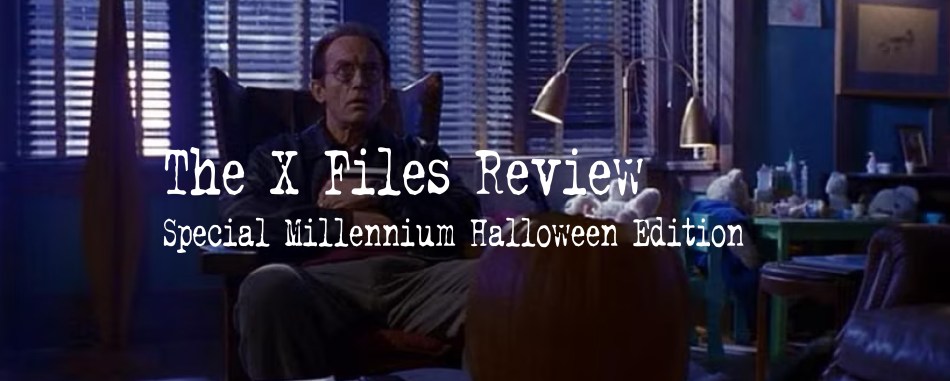
On a special Halloween edition of my X-Files blog, I’m going to discuss Chris Carter’s other series, Millennium. I’ve discussed it in passing through the last few seasons because Millennium aired during seasons four, five, and six of The X-Files. I’ve always believed that those three seasons of The X-Files were the series at its best and I think having Carter’s attention spread across both series during that era made them both better, even if Millennium had an existential crisis along the way.
Millennium started off great. The series followed Frank Black as he worked with law enforcement to solve crimes committed by serial killers. Frank could see into the minds of killers. Sense their evil. Envision what happened when they committed their crimes. This ability caused him great mental anguish, and understandably so. His character was even quoted saying, “I become what we fear most.” He was also a member of the Millennium Group, a cult that presented itself as a private investigating firm that helped solve the crimes committed by serial killers. They also wanted to and tried to end the world which is why Frank left the group during the series. It also affected his marriage when his wife discovered what the group really was.
The image most closely related to the Millennium Group is the ouroboros, which is a serpent eating it’s own tail. It has roots in Egyptian iconography and the name is derived from the Greek words meaning tail-devourer. It is a symbol of eternity. The endless cycle of life, death, and rebirth. Both The X-Files and Millennium had many characters who always made their way back to each other – Frank with the Millennium Group and Mulder and Scully with The Syndicate – so the utilization of the ouroboros certainly symbolizes this rotating arcs.
The series pivoted in season two which threw some viewers for a loop as the Millennium Group tried to artificially bring about the apocalypse by starting a viral outbreak near the end of the season. While the season finale suggests this would work, all they really ended up doing was making a few hundred people in Seattle sick – including Frank’s wife who lost her life due to the illness. The season three premiere shifted the series again, pulling back from the apocalypse and making it a small epidemic so that Frank could work directly with the FBI after he continued his estrangement from the Millennium Group. I for one didn’t mind this zigzag, but it lost the show a lot of viewership. A shame since season three has some great episodes and that is why I’m discussing Millennium today instead of Mulder and Scully’s season six adventures.
If you’re been following along with my blog, you’ll also know that season six was when The X-Files moved production to Los Angelos whilst Millennium stayed in Vancouver. Since Frank was working directly with FBI Agent Emma Hollis during season three, this season feels much more like The X-Files than some of The X-Files. I noticed this a lot while I was watching these two shows together during this rewatch. Maybe that is why I like season three so much. It felt more like The X-Files than some of the X-files.
Millennium did a couple of Halloween episodes. In season two, Frank carved a jack-o-lantern and took his daughter Jordan trick or treating while she was dressed in a Marge Simpson costume. In this episode, The Curse of Frank Black, Jordan – having inherited her father’s abilities to sense evil, refuses to go up to a house because she senses something is wrong there. Frank has a flashback of a horrible childhood memory, which aligns itself with the themes of childhood trauma and fear that the show used often with both cases and with Frank and his daughter. That ouroboros symbolism. We always end up back where we started.
Toward the end of season two, an episode entitled Somehow,Satan Got Behind Me featured four versions of Satan meeting in a coffee shop to talk about their dealings with humanity. All their stories have one thing in common, however. Frank Black. Season two was decidedly dark, so this episode written and directed by X-Files writer Darin Morgan was a welcome borderline parody of that season. Morgan also wrote episode Jose Chung’s Doomsday Defense this season which was a sister episode to the X-Files episode Jose Chung’s From Outer Space. All of these episodes rank among my favorites from both series.
During season three, Frank learns that the Millennium Group performed parapsychology experiments that lead to several deaths and had to help his daughter deal with the grief of losing her mother. Her own arc forces her to deal with her own childhood fears as she sees evil in a kid at school and Frank has to come to terms with the fact that he didn’t believe her at first. All this happened before episode five of that season. Entitled Thirteen Years Later, the fifth episode aired on October 30, 1998, an entire week before The X-Files season six premiere. It centered around Agent Hollis and Frank investigating murders on a horror movie set and Frank soon realizes that the movie is based on an old case he investigated. Again, that ouroboros symbolism, and this time its in an episode with a decidedly funny feel. The show as a whole was pretty dark, so having a funny episode now and then was a nice break.
This episode also guest starred the band Kiss, both in and out of their famous makeup. They even perform a song for the episode. I had completely forgotten that the band had appeared on the show since I hadn’t watched it since it originally aired. The band wasn’t the only familiar face to appear in season three. James Marsters, most famous for playing Spike on Buffy the Vampire Slayer, appeared in episode eleven as a disgruntled military vet who kidnaps Millennium Group member Peter Watts’ daughter. With the intention of exposing the group’s dark secrets, he gives the girl a virus. Watts was played by Terry O’Quinn (Lost, The X-Files Movie).
Most notably, Dean Norris guest starred in episode nineteen Seven and One as an FBI agent. This episode, written by Chris Carter, Frank Spotnitz, and Erin Maher, feels most like The X-Files as Norris’s character, Del Boxer, is meant to be within the X-Files universe. The episode itself yet again uses the themes of childhood trauma as Frank believes he is going crazy as he receives photographs showing his death. He believes someone is out to kill him while the agents around him think he is losing his mind. Dean Norris would later go on to work with X-Files writer Vince Gilligan on the series Breaking Bad with Bryan Cranston who starred in the second episode of season six of The X-Files. Full circle with that ouroboros symbolism again. For both of those actors to appear during the same year in these two series only to work together years later on a series created by Vince Gilligan really shows the effect that the X-Files universe had on pop culture. I’ll mention it one last time – that ouroboros symbolism. Circle of life.
If you haven’t revisited Millennium lately, I recommend it. You can find the series used on DVD as the discs are out of print now. I picked up a copy on Ebay. As of writing this, it is not streaming anywhere (shocking since it should be on Hulu of all places). I’ll mention this series one last time in season seven of The X-Files when the two shows finally officially crossover in what ended up being the unofficial finale to the Millennium series.
Happy Halloween, Awesome Nerds, and until next week, the truth is out there.
Discover more from Becky Tyler Art and Photography
Subscribe to get the latest posts sent to your email.




Hello, Boys and Ghouls.
On a special Halloween edition of my X-Files blog, I’m going to discuss Chris Carter’s other series, Millennium. I’ve discussed it in passing through the last few seasons because Millennium aired during seasons four, five, and six of The X-Files. I’ve always believed that those three seasons of The X-Files were the series at its best and I think having Carter’s attention spread across both series during that era made them both better, even if Millennium had an existential crisis along the way.
Millennium started off great. The series followed Frank Black as he worked with law enforcement to solve crimes committed by serial killers. Frank could see into the minds of killers. Sense their evil. Envision what happened when they committed their crimes. This ability caused him great mental anguish, and understandably so. His character was even quoted saying, “I become what we fear most.” He was also a member of the Millennium Group, a cult that presented itself as a private investigating firm that helped solve the crimes committed by serial killers. They also wanted to and tried to end the world which is why Frank left the group during the series. It also affected his marriage when his wife discovered what the group really was.
The image most closely related to the Millennium Group is the ouroboros, which is a serpent eating it’s own tail. It has roots in Egyptian iconography and the name is derived from the Greek words meaning tail-devourer. It is a symbol of eternity. The endless cycle of life, death, and rebirth. Both The X-Files and Millennium had many characters who always made their way back to each other – Frank with the Millennium Group and Mulder and Scully with The Syndicate – so the utilization of the ouroboros certainly symbolizes this rotating arcs.
The series pivoted in season two which threw some viewers for a loop as the Millennium Group tried to artificially bring about the apocalypse by starting a viral outbreak near the end of the season. While the season finale suggests this would work, all they really ended up doing was making a few hundred people in Seattle sick – including Frank’s wife who lost her life due to the illness. The season three premiere shifted the series again, pulling back from the apocalypse and making it a small epidemic so that Frank could work directly with the FBI after he continued his estrangement from the Millennium Group. I for one didn’t mind this zigzag, but it lost the show a lot of viewership. A shame since season three has some great episodes and that is why I’m discussing Millennium today instead of Mulder and Scully’s season six adventures.
If you’re been following along with my blog, you’ll also know that season six was when The X-Files moved production to Los Angelos whilst Millennium stayed in Vancouver. Since Frank was working directly with FBI Agent Emma Hollis during season three, this season feels much more like The X-Files than some of The X-Files. I noticed this a lot while I was watching these two shows together during this rewatch. Maybe that is why I like season three so much. It felt more like The X-Files than some of the X-files.
Millennium did a couple of Halloween episodes. In season two, Frank carved a jack-o-lantern and took his daughter Jordan trick or treating while she was dressed in a Marge Simpson costume. In this episode, The Curse of Frank Black, Jordan – having inherited her father’s abilities to sense evil, refuses to go up to a house because she senses something is wrong there. Frank has a flashback of a horrible childhood memory, which aligns itself with the themes of childhood trauma and fear that the show used often with both cases and with Frank and his daughter. That ouroboros symbolism. We always end up back where we started.
Toward the end of season two, an episode entitled Somehow, Satan Got Behind Me featured four versions of Satan meeting in a coffee shop to talk about their dealings with humanity. All their stories have one thing in common, however. Frank Black. Season two was decidedly dark, so this episode written and directed by X-Files writer Darin Morgan was a welcome borderline parody of that season. Morgan also wrote episode Jose Chung’s Doomsday Defense this season which was a sister episode to the X-Files episode Jose Chung’s From Outer Space. All of these episodes rank among my favorites from both series.
During season three, Frank learns that the Millennium Group performed parapsychology experiments that lead to several deaths and had to help his daughter deal with the grief of losing her mother. Her own arc forces her to deal with her own childhood fears as she sees evil in a kid at school and Frank has to come to terms with the fact that he didn’t believe her at first. All this happened before episode five of that season. Entitled Thirteen Years Later, the fifth episode aired on October 30, 1998, an entire week before The X-Files season six premiere. It centered around Agent Hollis and Frank investigating murders on a horror movie set and Frank soon realizes that the movie is based on an old case he investigated. Again, that ouroboros symbolism, and this time its in an episode with a decidedly funny feel. The show as a whole was pretty dark, so having a funny episode now and then was a nice break.
This episode also guest starred the band Kiss, both in and out of their famous makeup. They even perform a song for the episode. I had completely forgotten that the band had appeared on the show since I hadn’t watched it since it originally aired. The band wasn’t the only familiar face to appear in season three. James Marsters, most famous for playing Spike on Buffy the Vampire Slayer, appeared in episode eleven as a disgruntled military vet who kidnaps Millennium Group member Peter Watts’ daughter. With the intention of exposing the group’s dark secrets, he gives the girl a virus. Watts was played by Terry O’Quinn (Lost, The X-Files Movie).
Most notably, Dean Norris guest starred in episode nineteen Seven and One as an FBI agent. This episode, written by Chris Carter, Frank Spotnitz, and Erin Maher, feels most like The X-Files as Norris’s character, Del Boxer, is meant to be within the X-Files universe. The episode itself yet again uses the themes of childhood trauma as Frank believes he is going crazy as he receives photographs showing his death. He believes someone is out to kill him while the agents around him think he is losing his mind. Dean Norris would later go on to work with X-Files writer Vince Gilligan on the series Breaking Bad with Bryan Cranston who starred in the second episode of season six of The X-Files. Full circle with that ouroboros symbolism again. For both of those actors to appear during the same year in these two series only to work together years later on a series created by Vince Gilligan really shows the effect that the X-Files universe had on pop culture. I’ll mention it one last time – that ouroboros symbolism. Circle of life.
If you haven’t revisited Millennium lately, I recommend it. You can find the series used on DVD as the discs are out of print now. I picked up a copy on Ebay. As of writing this, it is not streaming anywhere (shocking since it should be on Hulu of all places). I’ll mention this series one last time in season seven of The X-Files when the two shows finally officially crossover in what ended up being the unofficial finale to the Millennium series.
Happy Halloween, Awesome Nerds, and until next week, the truth is out there.
Discover more from Becky Tyler Art and Photography
Subscribe to get the latest posts sent to your email.
Share this: