Stranger Things used our nostalgia for the 1980s and turned it into a modern cultural phenomenon. It used themes from much loved coming-of-age movies like Stand By Me, The Goonies, Stephen King’s It, and The Lost Boys and set them against the Upside Down, a place inspired by video games like Silent Hill and The Last of Us. Much like Ridley Scott did when he made Alien, Stranger Things plays on our fear of monsters and dark, confined spaces. Those of us who grew up as latchkey kids are all too familiar with the lack of parental presence throughout the show. Everything about Stranger Things feels familiar because we feel like we have lived it already and the Upside Down represents all the fears and dangers we experience in life. A mirror universe that corrupts our familiarity, making us uncomfortable knowing that it is populated by the very things we grew up fighting in Dungeons and Dragons. Our own imaginations are used against us. Turned into nightmares. And we love every minute of it. It’s why we can’t stop watching.
The ‘80s were known for many things and the use of outlandish colors is certainly something we think of when we remember the era. Neon was often color matched in crazy patterns on oversized clothing. Everything was bigger than it needed to be, from teased big-haired rock bands to shoulder pads to boom boxes. Stranger Things does not shy away from these inspirations. In fact, it uses them to its advantage in set pieces and lighting of the spaces the characters occupy.
The Byers Home
This house immediately sets up that Joyce isn’t rich. That this single mom struggles financially but does her very best for her sons. At first glance, the exterior seems rickety, but inside it feels like a home. Lived in by people who make the most of what little they have.
Inside the Byers home, their phone is yellow. The kind of phone where the coiled cord is needlessly long as it was in the time before cordless telephones. Their couch is covered in a crocheted yellow and white blanket, something my own family had in our house when I was growing up. The lampshades are yellow and ivory which give off yellowish light when the lights are on. Even some of the curtains and walls are yellow, especially in Will’s room. This decor is meant to show that Joyce Byers tried to make a comforting place for her sons to grow up. But once Will disappears and Joyce begins to believe that he is trying to reach out to her, this coloring begins to show the internal struggles of this little family. Joyce’s guilt for not noticing that Will never made it home until the following morning. Jonathon’s social awkwardness as he chooses to view the real world through the lens of a camera. Will’s obsession with Dungeons and Dragons because make believe is easier than the struggles of real life. Internal decay is ever present here, especially after Will is brought back from the Upside Down. It is obvious at the end of season one that what happened to him will likely be with him forever.
During seasons one and two, the house becomes a map. First, after Joyce covers the interior with holiday lights, it is her way of communicating with Will in the Upside Down. Then, after Will is brought home and begins drawing on pieces of paper in season two, Joyce forms a map from the drawings that Will made. With Bob’s help, of course. By the end of season three when it is believed that Hopper is dead, the house becomes the place where Eleven says goodbye to him as Joyce gives her the letter that he had written her in season two. Of all the homes in Stranger Things, it is the Byers house that has the biggest story to tell.
In season four when they have moved to California, Will’s room has yellow walls. The curtains are yellow in Eleven’s room. The yellow and white blanket is still strewn over the couch. Again, Joyce is trying her best to give a home to her children that now includes Eleven. Her phone is still yellow, only now it is cordless. An upgrade in her California home. It has a yellow window which gives off eerie yellow light when the sun shines through. She’s still trying to do her best even when a mysterious package from Russia has her and Argyle hopping on a plane and leaving those teenagers alone. Unsupervised. Because that is what the parents do in this show. What could possibly go wrong?
Castle Byers
How do two boys deal with their abusive father leaving? They build a fort. Jonathon and Will built the fort out in the woods as a refuge from who their father was. It became a place where Will could act out his creativity and, in the Upside Down, hide from the Demogorgon. The sign above the entrance gives it its name in childish painted yellow lettering. It was meant to be a happy place.
Hopper’s Cabin
Jim Hopper’s cabin is lit much in the same way the Byers home is, though his homemaking skills are lacking. The mismatched furniture, a red couch and a blue recliner with a smattering of crocheted blankets, are set under the yellow lighting of small lamps. Taxidermy decorates the walls. What was once a hunting cabin is now meant to be a home for Eleven. It shows Hopper’s internal struggles with grief over his daughter’s death, someone he couldn’t save, and his need to be a father to Eleven. To make up for the things in life he failed at. His cabin mirrors his own cracked mental health.
Eleven’s room is decorated in yellow hues making it a happy place for her to exist. Bedding and curtains the color of pale sunshine. The walls are painted a serene pale green. It becomes the place where she and Mike kiss and the place where she and Max become closer friends after their shopping trip at the mall. It is also her refuge when she and Hopper are fighting. The cabin itself often felt like a prison to her in season two, but that bedroom was just for her.
That Russian Gulag
Hopper’s season four liberation from the gulag by Joyce and Argyle was lit in two very different ways. Outside, the lighting was a depressing blue. Cold. Hopeless. Inside the gulag was sickly, dim incandescent lighting. Neither of these were meant to give any of the prisoners hope, let alone Hopper, who had no idea if Joyce received or understood his package. Even when she managed to find him, they still needed to escape the Demogorgon the Russian were using to kill prisoners and find their way home. The lighting here mirrors the difference between the Right Side Up and the Upside Down. Two variations of the same cruel, cold world.
The Wheeler House
The Wheeler basement becomes the gathering place for Mike and his friends and the hiding place for Eleven in season one. The yellow incandescent lighting settles on the cast-off patterned furniture and wood paneling like a forgotten home, but the boys and Eleven make it their own. It is their common ground. Their place of refuge when the real world is too scary. It is also the place in season three where Will, dressed in his purple robe, desperately tries to hold onto his childhood while Mike, Lucas, and Dustin move on from it.
Nancy’s room is what a teenage girl’s room would look like if you were Nancy Wheeler. Pink and white striped wallpaper. Pale green curtains. Blue and pink patchwork bedspread. Clean and orderly just like Nancy, a girl who eventually chooses monster hunting over popularity thanks to her guilt over Barb’s disappearance. The pastel pinks and blues show her gentleness and femininity still anchored in a little girl’s childhood.
Mike’s room is dark blue and covered in posters. A ONE WAY sign hanging on the wall shows his unflinching path forward even when it means being at odds with his friends. He defends Eleven even if Lucas stops talking to him in season one and puts Eleven first when Will wants him to play Dungeons and Dragons in season three. In season four, he goes out of his way not to notice the hurt he causes Will. He is the first friend to lash out stubbornly but the last friend to give up. This room tells that tale perfectly. The Wheeler siblings couldn’t be more different aesthetically, but they both have the same stubborn sense of right and wrong.
In season five, this house becomes an obstacle course. The place where Karen Wheeler tries to stop the Demogorgon from taking Holly. Both she and her husband are badly wounded as the Demogorgon creates passageways through the interior walls of the house to attack them. The reddish lighting from these portals stands out from the gentle yellow lighting in the house showing how dangerous the situation becomes as Karen Wheeler suddenly realizes that monsters are real.
The Hawkins National Laboratory
Inside the lab is where lighting becomes more of its own character. The place is as sterile as you can imagine with its tiled floors and ceilings and bright fluorescent lighting. For a place where such dangerous experiments are going on, this place looks as innocuous as a regular hospital on the inside. It isn’t until the gateway to the Upside Down is opened that the lighting turns red. A warning that the place is dangerous. As we learn the true beginnings of Vecna in later seasons, the red lighting from the Upside Down in that first season as a bright of a warning as you can imagine.
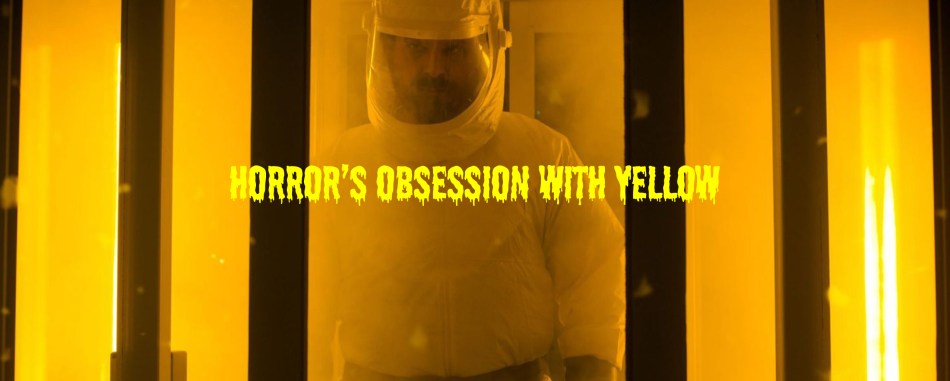
In the place where portal to the Upside Down was created and in the place where Eleven used the tub of water to move into people’s minds, the railing is painted bright yellow. Meant for the safety of workers, this yellow is a warning as well but with double meanings. Workplace safety, sure, but also a warning of the danger in their midst as they played with children’s minds. Whenever the lab workers suit up to either go into the Upside Down or to light the vines that extend from it on fire, the lighting turns yellow. But not the happy yellow Joyce Byers chose for her home. This yellow is sickly. The color of infection and rot. This signifies that whatever is in the Upside Down will infect everything if it isn’t stopped but also shows how the people running the lab don’t have the best of intentions. The moral decay of what those people call science is something that the people of Hawkins must stop repeatedly. The center of every evil thing that goes on there.
The Creel House
As the series progresses, we find that Henry – who become One at the lab and later Vecna in the Upside Down – lived in this house in the 1950s. Henry’s psychic powers cause mysterious events in the house which led to two deaths that are blamed on his father. It is revealed in one flashback on a Hawkins High School flyer that Henry was in a play with Joyce, Hopper, Karen Wheeler, and others so in all reality, this show is about how the actions of parents can drastically effect their children even if those actions were done before the kids were born. This also highlights themes in the show that were also popular in ‘80s films. Bullying is never the right way to treat people.
The exterior of the Creel house is dark blue and white. Dark blue is associated with stability, wisdom, and unity. That said, when the Creel family move into the house, their moving truck is yellow. A bright, shiny yellow. A warning that something wasn’t right with this family. The interior of the house, in stark contrast to that blue and white exterior, is an homage to haunted house horror movies. The walls are covered in yellow, orange, and green wallpaper and paints. Contrasting curtains highlight just how slightly off the color scheme is. It should feel comforting, but the lighting gives a sickly yellow glow to the place in the 1950s. The place where Henry would make his first kills.
In the 1980s, Nancy, Steve, Dustin, and company discover a gateway to the Upside Down in the house. Now, the house dusty and careworn, forgotten by time. The exterior boarded up, the paint having lost its luster. Truly something out of a horror movie. Once in the Upside Down, the veins of the place take over the house giving it an otherworldly appearance. Alive almost. With evil.
In season five, this is the place where Vecna/Henry/One brings Holly. At least, that is what her mind sees. The pristine version of the house that Henry knew as a child. Her view of the house is a safe place. It isn’t until Max reaches out to her that Holly begins to realize Henry isn’t her friend and the house isn’t the safe place she thought it was.
The Upside Down
From a technical standpoint, how we view the Upside Down is very intentional. A combination of flat lighting for depth and contrast and low-key lighting to emphasize shadows and contrast makes the place feel bleak. Unforgiving. The use of Leica prime lenses and RED cameras were used to deliver a soft image and shallow depth of field. This adds to the eeriness of the place. Add in the dust particles and echoey atmosphere, and the Upside Down becomes the place of nightmares. The actual source of light here is the other dimension. The Right Side Up.
The Demogorgon tends to cause electrical disruptions in the real world which is a warning sign that one is near. Will uses the Christmas lights Joyce hung in their home as a way of communicating with her, proving that such communication was possible between the two dimensions. When someone in the Right Side Up approaches a lamp or another light, it shimmers in the Upside Down. This is used multiple times to communicate back and forth in multiple seasons giving the view a visual connection between dimensions.
The Upside Down started out as dark blue and black, but the use of reds and oranges were used more in later seasons as Vecna’s influence and power grew. In season four, these reds were used whenever Vecna was trying to kill someone in the Upside Down. Max, who could hear music as her way out of the Upside Down, could see a circle of light in the red darkness for her to escape from. This visual is used multiple times in later seasons as a way of showing portals between the Upside Down and Right Side Up.
This color change from blues to reds is meant to show how dangerous and powerful Vecna is becoming. A warning. The first half of season five has shown him to be almost unbeatable except for one very interesting thing. Will, Vecna’s first victim in the Upside Down, can now see a bit into Vecna’s mind and has some of the same powers that Eleven has. What is so interesting about this connection is, as I discussed in my other Stranger Things blog about the character’s wardrobes, Will is often seen in yellow, red, and blue outfits. Almost every season. It mirrors the changes in color in the Upside down from dark blue to reds and oranges. I think the wardrobe department was subtly hinting about Will’s connection to Vecna this whole time.
Will’s new powers are both great for the people of Hawkins and bad for Will. It puts him in danger as he realizes that he can see into Henry/Vecna’s mind. That he can stop this villain from harming his friends, but at what cost to him? Will’s wardrobe also mimics that of Henry’s when he is dressed in his suit as an adult and when he was dressed as a scout as a child in his worst memory.
Will and Henry are connected to each other because the villain chose Will as the first person he dragged into the Upside Down. Will escapes and later becomes an integral part of defeating Henry/Vecna. The paralells in their wardrobe throughout the series is a great way of showing that especially since Henry/Vecna’s version of Hawkins, the Upside Down, is so vastly different. It shows that he was once human, and may still have some of that humanity left even as he chooses the evil living inside of him when Will connects with his mind and tries to stop him. This highlights Will’s resilience against evil even as Henry surrenders to it. At the end of the day, we always have a choice and it is that choice that defines us.
Happy New Year, Awesome Nerds. Until next time, don’t ride your bike home alone at night. You might end up in the Upside Down.
Discover more from Becky Tyler Art and Photography
Subscribe to get the latest posts sent to your email.




Chapter 16
Stranger Things used our nostalgia for the 1980s and turned it into a modern cultural phenomenon. It used themes from much loved coming-of-age movies like Stand By Me, The Goonies, Stephen King’s It, and The Lost Boys and set them against the Upside Down, a place inspired by video games like Silent Hill and The Last of Us. Much like Ridley Scott did when he made Alien, Stranger Things plays on our fear of monsters and dark, confined spaces. Those of us who grew up as latchkey kids are all too familiar with the lack of parental presence throughout the show. Everything about Stranger Things feels familiar because we feel like we have lived it already and the Upside Down represents all the fears and dangers we experience in life. A mirror universe that corrupts our familiarity, making us uncomfortable knowing that it is populated by the very things we grew up fighting in Dungeons and Dragons. Our own imaginations are used against us. Turned into nightmares. And we love every minute of it. It’s why we can’t stop watching.
The ‘80s were known for many things and the use of outlandish colors is certainly something we think of when we remember the era. Neon was often color matched in crazy patterns on oversized clothing. Everything was bigger than it needed to be, from teased big-haired rock bands to shoulder pads to boom boxes. Stranger Things does not shy away from these inspirations. In fact, it uses them to its advantage in set pieces and lighting of the spaces the characters occupy.
The Byers Home
This house immediately sets up that Joyce isn’t rich. That this single mom struggles financially but does her very best for her sons. At first glance, the exterior seems rickety, but inside it feels like a home. Lived in by people who make the most of what little they have.
Inside the Byers home, their phone is yellow. The kind of phone where the coiled cord is needlessly long as it was in the time before cordless telephones. Their couch is covered in a crocheted yellow and white blanket, something my own family had in our house when I was growing up. The lampshades are yellow and ivory which give off yellowish light when the lights are on. Even some of the curtains and walls are yellow, especially in Will’s room. This decor is meant to show that Joyce Byers tried to make a comforting place for her sons to grow up. But once Will disappears and Joyce begins to believe that he is trying to reach out to her, this coloring begins to show the internal struggles of this little family. Joyce’s guilt for not noticing that Will never made it home until the following morning. Jonathon’s social awkwardness as he chooses to view the real world through the lens of a camera. Will’s obsession with Dungeons and Dragons because make believe is easier than the struggles of real life. Internal decay is ever present here, especially after Will is brought back from the Upside Down. It is obvious at the end of season one that what happened to him will likely be with him forever.
During seasons one and two, the house becomes a map. First, after Joyce covers the interior with holiday lights, it is her way of communicating with Will in the Upside Down. Then, after Will is brought home and begins drawing on pieces of paper in season two, Joyce forms a map from the drawings that Will made. With Bob’s help, of course. By the end of season three when it is believed that Hopper is dead, the house becomes the place where Eleven says goodbye to him as Joyce gives her the letter that he had written her in season two. Of all the homes in Stranger Things, it is the Byers house that has the biggest story to tell.
In season four when they have moved to California, Will’s room has yellow walls. The curtains are yellow in Eleven’s room. The yellow and white blanket is still strewn over the couch. Again, Joyce is trying her best to give a home to her children that now includes Eleven. Her phone is still yellow, only now it is cordless. An upgrade in her California home. It has a yellow window which gives off eerie yellow light when the sun shines through. She’s still trying to do her best even when a mysterious package from Russia has her and Argyle hopping on a plane and leaving those teenagers alone. Unsupervised. Because that is what the parents do in this show. What could possibly go wrong?
Castle Byers
How do two boys deal with their abusive father leaving? They build a fort. Jonathon and Will built the fort out in the woods as a refuge from who their father was. It became a place where Will could act out his creativity and, in the Upside Down, hide from the Demogorgon. The sign above the entrance gives it its name in childish painted yellow lettering. It was meant to be a happy place.
Hopper’s Cabin
Jim Hopper’s cabin is lit much in the same way the Byers home is, though his homemaking skills are lacking. The mismatched furniture, a red couch and a blue recliner with a smattering of crocheted blankets, are set under the yellow lighting of small lamps. Taxidermy decorates the walls. What was once a hunting cabin is now meant to be a home for Eleven. It shows Hopper’s internal struggles with grief over his daughter’s death, someone he couldn’t save, and his need to be a father to Eleven. To make up for the things in life he failed at. His cabin mirrors his own cracked mental health.
Eleven’s room is decorated in yellow hues making it a happy place for her to exist. Bedding and curtains the color of pale sunshine. The walls are painted a serene pale green. It becomes the place where she and Mike kiss and the place where she and Max become closer friends after their shopping trip at the mall. It is also her refuge when she and Hopper are fighting. The cabin itself often felt like a prison to her in season two, but that bedroom was just for her.
That Russian Gulag
Hopper’s season four liberation from the gulag by Joyce and Argyle was lit in two very different ways. Outside, the lighting was a depressing blue. Cold. Hopeless. Inside the gulag was sickly, dim incandescent lighting. Neither of these were meant to give any of the prisoners hope, let alone Hopper, who had no idea if Joyce received or understood his package. Even when she managed to find him, they still needed to escape the Demogorgon the Russian were using to kill prisoners and find their way home. The lighting here mirrors the difference between the Right Side Up and the Upside Down. Two variations of the same cruel, cold world.
The Wheeler House
The Wheeler basement becomes the gathering place for Mike and his friends and the hiding place for Eleven in season one. The yellow incandescent lighting settles on the cast-off patterned furniture and wood paneling like a forgotten home, but the boys and Eleven make it their own. It is their common ground. Their place of refuge when the real world is too scary. It is also the place in season three where Will, dressed in his purple robe, desperately tries to hold onto his childhood while Mike, Lucas, and Dustin move on from it.
Nancy’s room is what a teenage girl’s room would look like if you were Nancy Wheeler. Pink and white striped wallpaper. Pale green curtains. Blue and pink patchwork bedspread. Clean and orderly just like Nancy, a girl who eventually chooses monster hunting over popularity thanks to her guilt over Barb’s disappearance. The pastel pinks and blues show her gentleness and femininity still anchored in a little girl’s childhood.
Mike’s room is dark blue and covered in posters. A ONE WAY sign hanging on the wall shows his unflinching path forward even when it means being at odds with his friends. He defends Eleven even if Lucas stops talking to him in season one and puts Eleven first when Will wants him to play Dungeons and Dragons in season three. In season four, he goes out of his way not to notice the hurt he causes Will. He is the first friend to lash out stubbornly but the last friend to give up. This room tells that tale perfectly. The Wheeler siblings couldn’t be more different aesthetically, but they both have the same stubborn sense of right and wrong.
In season five, this house becomes an obstacle course. The place where Karen Wheeler tries to stop the Demogorgon from taking Holly. Both she and her husband are badly wounded as the Demogorgon creates passageways through the interior walls of the house to attack them. The reddish lighting from these portals stands out from the gentle yellow lighting in the house showing how dangerous the situation becomes as Karen Wheeler suddenly realizes that monsters are real.
The Hawkins National Laboratory
Inside the lab is where lighting becomes more of its own character. The place is as sterile as you can imagine with its tiled floors and ceilings and bright fluorescent lighting. For a place where such dangerous experiments are going on, this place looks as innocuous as a regular hospital on the inside. It isn’t until the gateway to the Upside Down is opened that the lighting turns red. A warning that the place is dangerous. As we learn the true beginnings of Vecna in later seasons, the red lighting from the Upside Down in that first season as a bright of a warning as you can imagine.
In the place where portal to the Upside Down was created and in the place where Eleven used the tub of water to move into people’s minds, the railing is painted bright yellow. Meant for the safety of workers, this yellow is a warning as well but with double meanings. Workplace safety, sure, but also a warning of the danger in their midst as they played with children’s minds. Whenever the lab workers suit up to either go into the Upside Down or to light the vines that extend from it on fire, the lighting turns yellow. But not the happy yellow Joyce Byers chose for her home. This yellow is sickly. The color of infection and rot. This signifies that whatever is in the Upside Down will infect everything if it isn’t stopped but also shows how the people running the lab don’t have the best of intentions. The moral decay of what those people call science is something that the people of Hawkins must stop repeatedly. The center of every evil thing that goes on there.
The Creel House
As the series progresses, we find that Henry – who become One at the lab and later Vecna in the Upside Down – lived in this house in the 1950s. Henry’s psychic powers cause mysterious events in the house which led to two deaths that are blamed on his father. It is revealed in one flashback on a Hawkins High School flyer that Henry was in a play with Joyce, Hopper, Karen Wheeler, and others so in all reality, this show is about how the actions of parents can drastically effect their children even if those actions were done before the kids were born. This also highlights themes in the show that were also popular in ‘80s films. Bullying is never the right way to treat people.
The exterior of the Creel house is dark blue and white. Dark blue is associated with stability, wisdom, and unity. That said, when the Creel family move into the house, their moving truck is yellow. A bright, shiny yellow. A warning that something wasn’t right with this family. The interior of the house, in stark contrast to that blue and white exterior, is an homage to haunted house horror movies. The walls are covered in yellow, orange, and green wallpaper and paints. Contrasting curtains highlight just how slightly off the color scheme is. It should feel comforting, but the lighting gives a sickly yellow glow to the place in the 1950s. The place where Henry would make his first kills.
In the 1980s, Nancy, Steve, Dustin, and company discover a gateway to the Upside Down in the house. Now, the house dusty and careworn, forgotten by time. The exterior boarded up, the paint having lost its luster. Truly something out of a horror movie. Once in the Upside Down, the veins of the place take over the house giving it an otherworldly appearance. Alive almost. With evil.
In season five, this is the place where Vecna/Henry/One brings Holly. At least, that is what her mind sees. The pristine version of the house that Henry knew as a child. Her view of the house is a safe place. It isn’t until Max reaches out to her that Holly begins to realize Henry isn’t her friend and the house isn’t the safe place she thought it was.
The Upside Down
From a technical standpoint, how we view the Upside Down is very intentional. A combination of flat lighting for depth and contrast and low-key lighting to emphasize shadows and contrast makes the place feel bleak. Unforgiving. The use of Leica prime lenses and RED cameras were used to deliver a soft image and shallow depth of field. This adds to the eeriness of the place. Add in the dust particles and echoey atmosphere, and the Upside Down becomes the place of nightmares. The actual source of light here is the other dimension. The Right Side Up.
The Demogorgon tends to cause electrical disruptions in the real world which is a warning sign that one is near. Will uses the Christmas lights Joyce hung in their home as a way of communicating with her, proving that such communication was possible between the two dimensions. When someone in the Right Side Up approaches a lamp or another light, it shimmers in the Upside Down. This is used multiple times to communicate back and forth in multiple seasons giving the view a visual connection between dimensions.
The Upside Down started out as dark blue and black, but the use of reds and oranges were used more in later seasons as Vecna’s influence and power grew. In season four, these reds were used whenever Vecna was trying to kill someone in the Upside Down. Max, who could hear music as her way out of the Upside Down, could see a circle of light in the red darkness for her to escape from. This visual is used multiple times in later seasons as a way of showing portals between the Upside Down and Right Side Up.
This color change from blues to reds is meant to show how dangerous and powerful Vecna is becoming. A warning. The first half of season five has shown him to be almost unbeatable except for one very interesting thing. Will, Vecna’s first victim in the Upside Down, can now see a bit into Vecna’s mind and has some of the same powers that Eleven has. What is so interesting about this connection is, as I discussed in my other Stranger Things blog about the character’s wardrobes, Will is often seen in yellow, red, and blue outfits. Almost every season. It mirrors the changes in color in the Upside down from dark blue to reds and oranges. I think the wardrobe department was subtly hinting about Will’s connection to Vecna this whole time.
Will’s new powers are both great for the people of Hawkins and bad for Will. It puts him in danger as he realizes that he can see into Henry/Vecna’s mind. That he can stop this villain from harming his friends, but at what cost to him? Will’s wardrobe also mimics that of Henry’s when he is dressed in his suit as an adult and when he was dressed as a scout as a child in his worst memory.
Will and Henry are connected to each other because the villain chose Will as the first person he dragged into the Upside Down. Will escapes and later becomes an integral part of defeating Henry/Vecna. The paralells in their wardrobe throughout the series is a great way of showing that especially since Henry/Vecna’s version of Hawkins, the Upside Down, is so vastly different. It shows that he was once human, and may still have some of that humanity left even as he chooses the evil living inside of him when Will connects with his mind and tries to stop him. This highlights Will’s resilience against evil even as Henry surrenders to it. At the end of the day, we always have a choice and it is that choice that defines us.
Happy New Year, Awesome Nerds. Until next time, don’t ride your bike home alone at night. You might end up in the Upside Down.
Discover more from Becky Tyler Art and Photography
Subscribe to get the latest posts sent to your email.
Share this: