Chapter 31 – Horror in Victorian Literature Part 12
Belle Époque is French for Beautiful Era. Between the end of the Franco-Prussian War in 1871 until the beginning of World War I in 1914, this Belle Époque in France was a time of economic prosperity, optimism, and cultural and technological innovations. While London was covered in smog, Paris put in electric lighting earning the city the name “City of Light.” The Eiffel Tower was built for the 1889 World’s Fair. Cafés, cabarets, and salon culture flourished, giving the world the Moulin Rouge. Monet would cross the English Channel in 1899 and spend two years painting the London fog before returning to his art studio in France.
In the art world, Art Nouveau emerged in the art world and featured flowing lines and natural motifs. Monet would cross the English Channel in 1899 and spend two years painting the London fog before returning to his art studio in France. In fashion, rich jewel tones of emerald green, ruby red, and sapphire blues were combined with softer pastels and warm ivory. Gold gilded fashion and interior designs to express the artistic expression of a golden age of peace.
Underneath this, however, were growing social inequalities and political tensions. Everything new was opposed by reactionary groups who portrayed the age as decadent, degenerate, and the rise of anti-Semitism grew across France. Anyone who has read a history book knows who rose to power in Germany in 1933, so seeing this during a time of supposed prosperity isn’t surprising.
But I’m not here to talk about war or Hitler. Today I’m discussing The Palais Garnier – the famed opulent Paris opera house built between 1861 and 1875 at the behest of Napoleon III. While it isn’t as famous as Notre Dame Cathedral or the Louvre, it does have some notoriety thanks to Gaston Leroux’s 1910 novel The Phantom of the Opera.
This novel was based on rumors of a ghost living under the opera house near the supposed underground lake. In reality, the lake is just a massive concrete water cistern that serves as reservoir that manages groundwater pressure from the local high water table. Unfortunately for the opera house because emptying the cistern would actually change the structural pressure equilibrium of the building above because of its massive size, but fortunately for us because it gave Leroux a great setting for the lair of the man who was rumored to live there.
The phantom in Leroux’s story is a creative genius when it comes to writing an opera. His scarred face meant high society equated deformity with moral corruption. And that mask made famous in film and theatre adaptations? An allegory for how his scars hide his musical genius and capacity to love. That doesn’t make the Phantom innocent. He uses his music to manipulate. It is his weapon of control as well as his form of expression, and his time in seclusion from society has turned his mind to revenge when the woman he loves chooses another. The opera house itself is where art reveals the depths of the human soul. A place where a lonely, scarred human being can express things he would not have been able to otherwise. I believe this is what endears people to this story.
How Penny Dreadful Borrowed From This
Victor Frankenstein’s first creature, who named himself John Clare, took up a job as a handyman at an opera house in London. He learned how to change sets between acts and helped with the lighting. During this, he also grew close to one of the actresses. She is kind to him and befriends him. John Clare misinterprets this affection for something more than what it is and when he makes his feelings known, she distances herself. She still couldn’t see past his scarred face and, let’s be honest, he was a reanimated corpse. The parallels between John Clare and the Phantom were the same. Society would never welcome them on a meaningful level regardless of what they had to offer.
Adaptations of the Novel
Lon Chaney first brought the Phantom to life in the 1925 silent film. The unmasking scene is great especially if you know the backstory of Chaney’s self-applied makeup that created the skull like face. Universal would remake this in 1943 with all that technicolor had to offer giving the Phantom an acid scar instead of a birth defect. Hammer would take a shot at making a Phantom of the Opera film and tried for a more sympathetic Phantom. Dario Argento even adapted it into a 1998 film featuring Julian Sands and Asia Argento.
Perhaps the most famous adaption, though, was done for the stage before it was adapted into a film directed by Joel Schumacher. In 1986, Andrew Lloyd Webber’s music with lyrics by Charles Hard and Rickard Stilgoe would open at Her Majesty’s Theater in London’s West End. It would not open on Broadway at the Majestic Theatre until January 26, 1988. The opera was so popular that it would run for 35 years before closing on April 16, 1923. Personally speaking, I saw it in 1997 at Pantages Theater in Toronto and I’ve been obsessed ever since with three more viewings over the years when it visits the Orpheum Theatre in Minneapolis.
Director Joel Schumacher’s film 2004 adaptation of the musical features then relative unknowns Gerard Butler, Emmy Rossum, and Patrick Wilson under the condition by the director that they all sing their own songs. And they did wonderfully, but this is a color in horror blog so let me get down to how this film adeptly used the color of the time period to make a modern movie masterpiece.
The Phantom’s lair is surrounded by green water. A sickly green as if the chlorine mixture wasn’t right. The candlelight used cast delicate dancing shadows and yellow light whenever the Phantom and Christine were there together. She was always dressed in white to show her innocence, not that we needed to know how naïve she was. She believed that the Phantom was her dead father speaking to her and, as she put it, gave her mind blindly. At the end of the film, during the final fight, the Phantom is wearing red. This shows his rage but also his passionate love for Christine. It was an abusive, manipulative love, but it was love nonetheless even when it turned deadly.
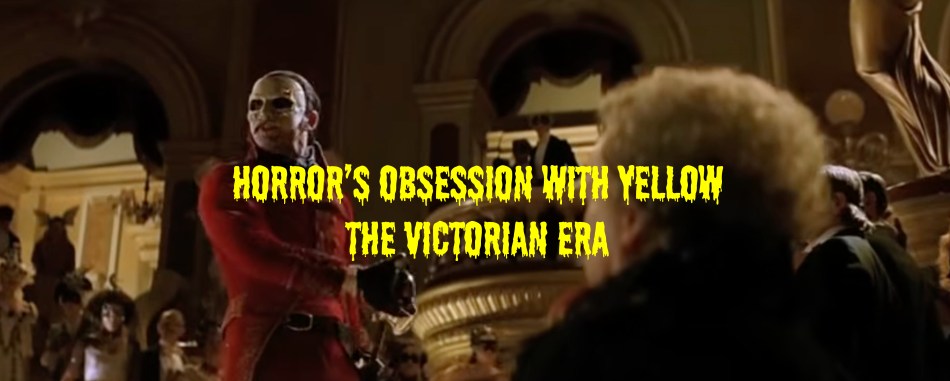
My favorite scene in the film is when they cast sings Masquerade in the hall of the Opera House. The entire cast is dressed in black and white costumes set against the red painted walls of the opera house and the marble floors and gold gilded highlights of the staircase. Men painted in gold paint hold up gold candelabras. Around them, the people in costume dance and sing around them. Christine enters with Raul, she in pastel pink singing about their secret engagement.
Remember when I talked about this era in France? How they mixed bright jewel tones with pastels and gold highlights? This scene gets that perfectly especially with Christine’s pink dress set against all the black and white and gold. When the Phantom enters wearing all red among the sea of black and white costumes, it is obvious he has sinister motives. The gold painted men who could have been statues until that moment turn to look up at him, this artistic menace demanding his due.
As far as book turned musical turned movie adaptations go, this one is at the top of my list of favorites. This is why I took this little field trip to Paris during this Victorian era London blog series. I had to include it. It borrows so heavily from the atmospheric qualities that I think of in regards to the Victorian era – the opulent reds, the golden set pieces, the moody foggy lake – that I couldn’t not include it.
Discover more from Becky Tyler Art and Photography
Subscribe to get the latest posts sent to your email.




Chapter 31 – Horror in Victorian Literature Part 12
Belle Époque is French for Beautiful Era. Between the end of the Franco-Prussian War in 1871 until the beginning of World War I in 1914, this Belle Époque in France was a time of economic prosperity, optimism, and cultural and technological innovations. While London was covered in smog, Paris put in electric lighting earning the city the name “City of Light.” The Eiffel Tower was built for the 1889 World’s Fair. Cafés, cabarets, and salon culture flourished, giving the world the Moulin Rouge. Monet would cross the English Channel in 1899 and spend two years painting the London fog before returning to his art studio in France.
In the art world, Art Nouveau emerged in the art world and featured flowing lines and natural motifs. Monet would cross the English Channel in 1899 and spend two years painting the London fog before returning to his art studio in France. In fashion, rich jewel tones of emerald green, ruby red, and sapphire blues were combined with softer pastels and warm ivory. Gold gilded fashion and interior designs to express the artistic expression of a golden age of peace.
Underneath this, however, were growing social inequalities and political tensions. Everything new was opposed by reactionary groups who portrayed the age as decadent, degenerate, and the rise of anti-Semitism grew across France. Anyone who has read a history book knows who rose to power in Germany in 1933, so seeing this during a time of supposed prosperity isn’t surprising.
But I’m not here to talk about war or Hitler. Today I’m discussing The Palais Garnier – the famed opulent Paris opera house built between 1861 and 1875 at the behest of Napoleon III. While it isn’t as famous as Notre Dame Cathedral or the Louvre, it does have some notoriety thanks to Gaston Leroux’s 1910 novel The Phantom of the Opera.
This novel was based on rumors of a ghost living under the opera house near the supposed underground lake. In reality, the lake is just a massive concrete water cistern that serves as reservoir that manages groundwater pressure from the local high water table. Unfortunately for the opera house because emptying the cistern would actually change the structural pressure equilibrium of the building above because of its massive size, but fortunately for us because it gave Leroux a great setting for the lair of the man who was rumored to live there.
The phantom in Leroux’s story is a creative genius when it comes to writing an opera. His scarred face meant high society equated deformity with moral corruption. And that mask made famous in film and theatre adaptations? An allegory for how his scars hide his musical genius and capacity to love. That doesn’t make the Phantom innocent. He uses his music to manipulate. It is his weapon of control as well as his form of expression, and his time in seclusion from society has turned his mind to revenge when the woman he loves chooses another. The opera house itself is where art reveals the depths of the human soul. A place where a lonely, scarred human being can express things he would not have been able to otherwise. I believe this is what endears people to this story.
How Penny Dreadful Borrowed From This
Victor Frankenstein’s first creature, who named himself John Clare, took up a job as a handyman at an opera house in London. He learned how to change sets between acts and helped with the lighting. During this, he also grew close to one of the actresses. She is kind to him and befriends him. John Clare misinterprets this affection for something more than what it is and when he makes his feelings known, she distances herself. She still couldn’t see past his scarred face and, let’s be honest, he was a reanimated corpse. The parallels between John Clare and the Phantom were the same. Society would never welcome them on a meaningful level regardless of what they had to offer.
Adaptations of the Novel
Lon Chaney first brought the Phantom to life in the 1925 silent film. The unmasking scene is great especially if you know the backstory of Chaney’s self-applied makeup that created the skull like face. Universal would remake this in 1943 with all that technicolor had to offer giving the Phantom an acid scar instead of a birth defect. Hammer would take a shot at making a Phantom of the Opera film and tried for a more sympathetic Phantom. Dario Argento even adapted it into a 1998 film featuring Julian Sands and Asia Argento.
Perhaps the most famous adaption, though, was done for the stage before it was adapted into a film directed by Joel Schumacher. In 1986, Andrew Lloyd Webber’s music with lyrics by Charles Hard and Rickard Stilgoe would open at Her Majesty’s Theater in London’s West End. It would not open on Broadway at the Majestic Theatre until January 26, 1988. The opera was so popular that it would run for 35 years before closing on April 16, 1923. Personally speaking, I saw it in 1997 at Pantages Theater in Toronto and I’ve been obsessed ever since with three more viewings over the years when it visits the Orpheum Theatre in Minneapolis.
Director Joel Schumacher’s film 2004 adaptation of the musical features then relative unknowns Gerard Butler, Emmy Rossum, and Patrick Wilson under the condition by the director that they all sing their own songs. And they did wonderfully, but this is a color in horror blog so let me get down to how this film adeptly used the color of the time period to make a modern movie masterpiece.
The Phantom’s lair is surrounded by green water. A sickly green as if the chlorine mixture wasn’t right. The candlelight used cast delicate dancing shadows and yellow light whenever the Phantom and Christine were there together. She was always dressed in white to show her innocence, not that we needed to know how naïve she was. She believed that the Phantom was her dead father speaking to her and, as she put it, gave her mind blindly. At the end of the film, during the final fight, the Phantom is wearing red. This shows his rage but also his passionate love for Christine. It was an abusive, manipulative love, but it was love nonetheless even when it turned deadly.
My favorite scene in the film is when they cast sings Masquerade in the hall of the Opera House. The entire cast is dressed in black and white costumes set against the red painted walls of the opera house and the marble floors and gold gilded highlights of the staircase. Men painted in gold paint hold up gold candelabras. Around them, the people in costume dance and sing around them. Christine enters with Raul, she in pastel pink singing about their secret engagement.
Remember when I talked about this era in France? How they mixed bright jewel tones with pastels and gold highlights? This scene gets that perfectly especially with Christine’s pink dress set against all the black and white and gold. When the Phantom enters wearing all red among the sea of black and white costumes, it is obvious he has sinister motives. The gold painted men who could have been statues until that moment turn to look up at him, this artistic menace demanding his due.
As far as book turned musical turned movie adaptations go, this one is at the top of my list of favorites. This is why I took this little field trip to Paris during this Victorian era London blog series. I had to include it. It borrows so heavily from the atmospheric qualities that I think of in regards to the Victorian era – the opulent reds, the golden set pieces, the moody foggy lake – that I couldn’t not include it.
Discover more from Becky Tyler Art and Photography
Subscribe to get the latest posts sent to your email.
Share this: