Chapter 27 – Horror in Victorian Literature Part 8
Before I get into today’s subject, I’ll fully admit that I was only going to mention this short story in passing as it did inspire Bram Stoker’s Dracula. As I was making my way through the Victorian era literature I’ve been writing about, this particular short story hit me over the head an ah-ha moment. There, in one of the first paragraphs, a familiar name. One that I had stumbled across during my research for my 2025 series when I started the Yellow in Horror blog. That name was Karnstein. In that moment, I knew that Carmilla wasn’t something I could only mention in passing. Research of this short story also led me to Charlotte Perkins Gilman’s The Yellow Wallpaper as both of these short stories served as inspiration for one Spanish film that I’m about to talk about.
In 1872, Irish writer Joseph Sheridan Le Fanu would publish the vampire story Carmilla as a serialized piece in The Dark Blue, a London based literary magazine. Afterwards, the story would appear in a collection of short stories entitled In a Glass Darkly. The story featured a female vampire and is the first known published vampire story to have lesbian undertones. It served as in inspiration for the German film Vampyr released in 1931, though the lesbianism is far removed from the film. Sapphic erotica wasn’t going to do the film any favors in 1931. That would come later. Much later. In the 1970s.
The short story itself is populated by descriptions of ruined towers (the old Karnstein castle) covered in grey ivy and shadow. Of old tapestries that showed Cleopatra and the asps set against a gold carving that “redeemed the gloom of the old tapestry.” Of the character Camilla wearing a white nightgown and being bathed in blood from her chin to her feet. It is told through the lens of a young woman who had a female guest staying with her family right as mysterious deaths of young women around the county were occurring. They would soon find that Carmilla was actually Mircalla and Millarca, a vampire who doesn’t age and has been sucking the blood of unsuspecting women. How she was able to leave her tomb and get back into it without it ever opening remained a mystery, but that didn’t stop locals from destroying her body. It was a fantastic read and I highly recommend if you haven’t read it. I can see how Bram Stoker was so inspired by it when it came to writing about literature’s most famous vampire.
Hammer Horror’s Adaptation
Between 1970 and 1971, Hammer Horror released a trilogy of horror films based on Carmilla. They did what Vampyr couldn’t – they featured the lesbianism front and center and Carmilla uses the passionate, physical intimacy as a way to calm her victims into allowing them to take their blood. Hammer didn’t shy away from the sapphic undertones of the source material, especially in the first film, The Vampire Lovers. Through this intimacy, the film also speaks to the sexual suppression women were subjected to in Victorian society as that era viewed female expression in such a way that desire was as evil as the vampirism itself. The clash between Victorian society and female sexuality was a theme throughout the Victorian era thanks to the generations of patriarchal control that came before the era even started.
Remember when I mentioned that ah-ha moment at seeing the Karnstein name? It was from this trilogy that I had originally heard the name. Cue me grabbing my computer and doing an hours long Google search about the adaptations of Carmilla and then spending too much money on out-of-print DVDs and Blu rays floating around eBay so I could watch them before I published this. Very few of these movies are available to watch online and if they are, they are either behind a pay wall or are on a service that requires sitting through a lot of ads. It’s why I prefer physical media.
What is so interesting is that Hammer made a trilogy of this story. It expands the lore of the Karnstein family and casts Peter Cushing as different characters in the first and third films. The second and third films only serve as a loose adaptation and each can be seen without having watched the other two for the characters are different in each. The first film, The Vampire Lovers, most closely resembles the story itself and used lush, decadent set pieces that highlighted both the Victorian Era and the Aesthetic Movement that occurred during the time period. It highlighted the gothic tone of the film with exteriors shrouded in fog and shadowy lighting. The erotic atmosphere was set against intimate candle lit bedchambers.
Much like the original source material, the film used long, flowing white nightgowns. This highlighted the red when Carmilla had blood flowing down her nightgown in one of the protagonist’s nightmares. White, often associated with innocence – it is why wedding gowns are white, to make the bride look virginal – but in this film, it is associated with the power and control Carmilla uses over her victims. Decadence was often associated with the Victorian era, so the daytime gowns were extravagant and lowcut to go with the lesbian vibe. Carmilla may be a liberating force when it comes to sexuality, awaking suppressed desires before her true nature takes over. That destruction of societal rules is also her undoing as men can’t allow her to have that much control.
Both of the sequels, Lust for a Vampire and Twins of Evil, expand upon the Karnstein lore and serve as stand alone films as well as sequels. Lust for a Vampire even uses obviously polyester fabrics that are almost metallic in nature as they look duotone in the lighting. Pink one moment and purple the next. I’d like to say that this was an intentional choice to go with themes of the vampire not always being what they seem, but those polyester costumes aren’t that deep. I always make jokes about this since polyester didn’t exist in the Victorian era, but I’m sure it was just one of Hammer Horror’s cost cutting measures that the studio was known for. They did enjoy their micro budgets.
The control exhibited by Mircalla (Carmilla using one of her anagram names) in Lust of a Vampire not only gets the women around her, but one of the men. The male gaze is far more prominent in this film as she seduces both men and women as the film doesn’t genuinely explore queerness, but instead frames the seduction as a heterosexual man’s fantasy. The other interesting theme of this film that takes place at an all-girls finishing school where the purity of youth is supposed to be what these girls exhibit but they and the faculty members are corrupted by Mircalla’s seduction. The school is right next to the ruins of Karnstein castle, so the castle burning in the climax of the film signifies the return to societal norms. Patriarchal control wins out burning that terrible female expressionism in the process.
Twins of Evil utilized yellow and green much more than the other two films to show the moral decay of both the characters and the local society, even giving one of the twins a yellow gown that she wore when the Karnstein vampire turned her into one. Here, Karnstein himself is the manipulator when he turns Freida into a vampire. Then, and only then, does female empowerment become front and center before the patriarchy burns it down. That yellow gown shows Frieda’s loss of innocence amid a storyline that includes her uncle, played by Peter Cushing, almost burning her sister Maria at the stake for mistaking her as Frieda. The duality of these twins, Maria being the pure, pious one and Frieda being the rebellious breaker of societal norms, is one of the main themes throughout the film as Cushing’s character finds that he himself has been manipulated into burning innocent women at the stake because he viewed female empowerment as evil. It blinded him to seeing where the evil truly lay – in the male control of Karnstein himself. In the puritanical vigilante mob vengeance that terrorizes innocent townspeople more than it is at all effectual in stomping out evil. Patriarchal trauma is most prominent in this film as the blind extremism of the religious fanaticism is an equally destructive force against innocent people as it is against monsters, actual and perceived. This is my favorite in the trilogy for this reason.
Spain Gets in on Carmilla Adaptations
The Blood Spattered Bride is a more modern take on the story that twists the narrative into a young bride meeting Carmilla on her honeymoon instead of having Carmilla stay at her house as a young woman. While this adaptation does not take place in the Victorian era but in a more modern car driving society, the narrative still centers around the power struggle between the sexes as a husband and the seductive vampire fight over control of one woman’s mind and body. The husband has some extreme sexual appetites to the point of perversion and it alienates his own wife. It is Carmilla who awakens her repressed desires leading to the rebellion against male control. The husband represents a more modern chauvinistic version of patriarchal control. Many believe this film is an allegory against oppressive Franco-era regimes in Spain which shows how horror is political. Always has been – the Carmilla adaptations across the board are great examples – from puritanical witch hunts by blind religious zealots to the oppressive control of cultural suppression that proliferated under the Nationalist regime in Spain in the 1930s.
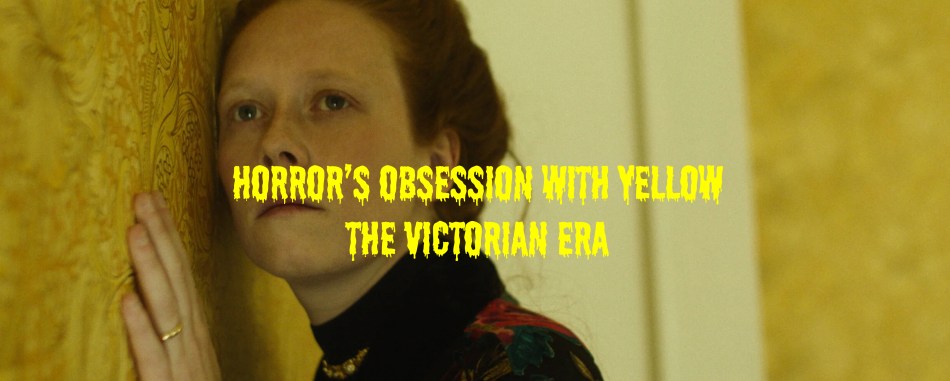
The Blood Spattered Bride uses yellow wallpaper throughout the film after the bride, Susan, is prescribed to bedrest after doctors say her issues with her husband’s sexual proclivities are just “female hysteria”. Confined to a room to stare at yellow wallpaper. Though the story within the film is loosely based on le Fanu’s Carmilla, this particular sequence is a direct nod to Charlotte Perkins Gilman’s 1892 story The Yellow Wallpaper. That yellow wallpaper is a literal symbol of how the oppressive constraints the patriarchy puts on women drives us mad. Gilman wrote the story as a way of condemning the 19th century medical treatments that often isolated women which she experiences herself.
I’ve talked a lot about how the Aesthetic Movement used yellow in a bright, happy, sunshiny capacity. The Blood Spattered Bride, though it took inspiration from two Victorian era stories, took the color yellow and stripped away any warmth from it. Susan’s inner turmoil over her husband’s chauvinism is set against a color that was very much a metaphor for decay and illness. She then turns to Camilla whose bloody rebellion of societal norms gives her new clarity. The framework of the original story is there, just told through the eyes of an oppressed Spain.
Recent adaptations of Carmilla are far less enjoyable to watch. A 2019 version of the same name is a slow burn of a film that has no payoff at the end to justify the slowness of the film as a whole. While it does touch on the loneliness of one girl who can’t seem to escape the control of her father, it does not have the deeper meanings that Hammer Horror’s trilogy and The Blood Spattered Bride had back in the 1970s.
There is also an adaptation of The Yellow Wallpaper from 2021 that excels in an atmospheric and haunting portrayal one woman’s mental deterioration as she is stuck staring at the yellow wallpaper on the walls around her. While the sound design and cinematography is great, this slow burn, much like the 2019 Carmilla adaptation, suffers from excessive slowness with no real payoff at the end to make sitting through it worth it. Read the short story instead.
But… Dracula Bram Stoker took inspiration from le Fanu’s short story when he wrote Dracula. And that will be the topic of my next two blogs. I hope you’ll be around to sink your teeth into them.
Discover more from Becky Tyler Art and Photography
Subscribe to get the latest posts sent to your email.




Chapter 27 – Horror in Victorian Literature Part 8
Before I get into today’s subject, I’ll fully admit that I was only going to mention this short story in passing as it did inspire Bram Stoker’s Dracula. As I was making my way through the Victorian era literature I’ve been writing about, this particular short story hit me over the head an ah-ha moment. There, in one of the first paragraphs, a familiar name. One that I had stumbled across during my research for my 2025 series when I started the Yellow in Horror blog. That name was Karnstein. In that moment, I knew that Carmilla wasn’t something I could only mention in passing. Research of this short story also led me to Charlotte Perkins Gilman’s The Yellow Wallpaper as both of these short stories served as inspiration for one Spanish film that I’m about to talk about.
In 1872, Irish writer Joseph Sheridan Le Fanu would publish the vampire story Carmilla as a serialized piece in The Dark Blue, a London based literary magazine. Afterwards, the story would appear in a collection of short stories entitled In a Glass Darkly. The story featured a female vampire and is the first known published vampire story to have lesbian undertones. It served as in inspiration for the German film Vampyr released in 1931, though the lesbianism is far removed from the film. Sapphic erotica wasn’t going to do the film any favors in 1931. That would come later. Much later. In the 1970s.
The short story itself is populated by descriptions of ruined towers (the old Karnstein castle) covered in grey ivy and shadow. Of old tapestries that showed Cleopatra and the asps set against a gold carving that “redeemed the gloom of the old tapestry.” Of the character Camilla wearing a white nightgown and being bathed in blood from her chin to her feet. It is told through the lens of a young woman who had a female guest staying with her family right as mysterious deaths of young women around the county were occurring. They would soon find that Carmilla was actually Mircalla and Millarca, a vampire who doesn’t age and has been sucking the blood of unsuspecting women. How she was able to leave her tomb and get back into it without it ever opening remained a mystery, but that didn’t stop locals from destroying her body. It was a fantastic read and I highly recommend if you haven’t read it. I can see how Bram Stoker was so inspired by it when it came to writing about literature’s most famous vampire.
Hammer Horror’s Adaptation
Between 1970 and 1971, Hammer Horror released a trilogy of horror films based on Carmilla. They did what Vampyr couldn’t – they featured the lesbianism front and center and Carmilla uses the passionate, physical intimacy as a way to calm her victims into allowing them to take their blood. Hammer didn’t shy away from the sapphic undertones of the source material, especially in the first film, The Vampire Lovers. Through this intimacy, the film also speaks to the sexual suppression women were subjected to in Victorian society as that era viewed female expression in such a way that desire was as evil as the vampirism itself. The clash between Victorian society and female sexuality was a theme throughout the Victorian era thanks to the generations of patriarchal control that came before the era even started.
Remember when I mentioned that ah-ha moment at seeing the Karnstein name? It was from this trilogy that I had originally heard the name. Cue me grabbing my computer and doing an hours long Google search about the adaptations of Carmilla and then spending too much money on out-of-print DVDs and Blu rays floating around eBay so I could watch them before I published this. Very few of these movies are available to watch online and if they are, they are either behind a pay wall or are on a service that requires sitting through a lot of ads. It’s why I prefer physical media.
What is so interesting is that Hammer made a trilogy of this story. It expands the lore of the Karnstein family and casts Peter Cushing as different characters in the first and third films. The second and third films only serve as a loose adaptation and each can be seen without having watched the other two for the characters are different in each. The first film, The Vampire Lovers, most closely resembles the story itself and used lush, decadent set pieces that highlighted both the Victorian Era and the Aesthetic Movement that occurred during the time period. It highlighted the gothic tone of the film with exteriors shrouded in fog and shadowy lighting. The erotic atmosphere was set against intimate candle lit bedchambers.
Much like the original source material, the film used long, flowing white nightgowns. This highlighted the red when Carmilla had blood flowing down her nightgown in one of the protagonist’s nightmares. White, often associated with innocence – it is why wedding gowns are white, to make the bride look virginal – but in this film, it is associated with the power and control Carmilla uses over her victims. Decadence was often associated with the Victorian era, so the daytime gowns were extravagant and lowcut to go with the lesbian vibe. Carmilla may be a liberating force when it comes to sexuality, awaking suppressed desires before her true nature takes over. That destruction of societal rules is also her undoing as men can’t allow her to have that much control.
Both of the sequels, Lust for a Vampire and Twins of Evil, expand upon the Karnstein lore and serve as stand alone films as well as sequels. Lust for a Vampire even uses obviously polyester fabrics that are almost metallic in nature as they look duotone in the lighting. Pink one moment and purple the next. I’d like to say that this was an intentional choice to go with themes of the vampire not always being what they seem, but those polyester costumes aren’t that deep. I always make jokes about this since polyester didn’t exist in the Victorian era, but I’m sure it was just one of Hammer Horror’s cost cutting measures that the studio was known for. They did enjoy their micro budgets.
The control exhibited by Mircalla (Carmilla using one of her anagram names) in Lust of a Vampire not only gets the women around her, but one of the men. The male gaze is far more prominent in this film as she seduces both men and women as the film doesn’t genuinely explore queerness, but instead frames the seduction as a heterosexual man’s fantasy. The other interesting theme of this film that takes place at an all-girls finishing school where the purity of youth is supposed to be what these girls exhibit but they and the faculty members are corrupted by Mircalla’s seduction. The school is right next to the ruins of Karnstein castle, so the castle burning in the climax of the film signifies the return to societal norms. Patriarchal control wins out burning that terrible female expressionism in the process.
Twins of Evil utilized yellow and green much more than the other two films to show the moral decay of both the characters and the local society, even giving one of the twins a yellow gown that she wore when the Karnstein vampire turned her into one. Here, Karnstein himself is the manipulator when he turns Freida into a vampire. Then, and only then, does female empowerment become front and center before the patriarchy burns it down. That yellow gown shows Frieda’s loss of innocence amid a storyline that includes her uncle, played by Peter Cushing, almost burning her sister Maria at the stake for mistaking her as Frieda. The duality of these twins, Maria being the pure, pious one and Frieda being the rebellious breaker of societal norms, is one of the main themes throughout the film as Cushing’s character finds that he himself has been manipulated into burning innocent women at the stake because he viewed female empowerment as evil. It blinded him to seeing where the evil truly lay – in the male control of Karnstein himself. In the puritanical vigilante mob vengeance that terrorizes innocent townspeople more than it is at all effectual in stomping out evil. Patriarchal trauma is most prominent in this film as the blind extremism of the religious fanaticism is an equally destructive force against innocent people as it is against monsters, actual and perceived. This is my favorite in the trilogy for this reason.
Spain Gets in on Carmilla Adaptations
The Blood Spattered Bride is a more modern take on the story that twists the narrative into a young bride meeting Carmilla on her honeymoon instead of having Carmilla stay at her house as a young woman. While this adaptation does not take place in the Victorian era but in a more modern car driving society, the narrative still centers around the power struggle between the sexes as a husband and the seductive vampire fight over control of one woman’s mind and body. The husband has some extreme sexual appetites to the point of perversion and it alienates his own wife. It is Carmilla who awakens her repressed desires leading to the rebellion against male control. The husband represents a more modern chauvinistic version of patriarchal control. Many believe this film is an allegory against oppressive Franco-era regimes in Spain which shows how horror is political. Always has been – the Carmilla adaptations across the board are great examples – from puritanical witch hunts by blind religious zealots to the oppressive control of cultural suppression that proliferated under the Nationalist regime in Spain in the 1930s.
The Blood Spattered Bride uses yellow wallpaper throughout the film after the bride, Susan, is prescribed to bedrest after doctors say her issues with her husband’s sexual proclivities are just “female hysteria”. Confined to a room to stare at yellow wallpaper. Though the story within the film is loosely based on le Fanu’s Carmilla, this particular sequence is a direct nod to Charlotte Perkins Gilman’s 1892 story The Yellow Wallpaper. That yellow wallpaper is a literal symbol of how the oppressive constraints the patriarchy puts on women drives us mad. Gilman wrote the story as a way of condemning the 19th century medical treatments that often isolated women which she experiences herself.
I’ve talked a lot about how the Aesthetic Movement used yellow in a bright, happy, sunshiny capacity. The Blood Spattered Bride, though it took inspiration from two Victorian era stories, took the color yellow and stripped away any warmth from it. Susan’s inner turmoil over her husband’s chauvinism is set against a color that was very much a metaphor for decay and illness. She then turns to Camilla whose bloody rebellion of societal norms gives her new clarity. The framework of the original story is there, just told through the eyes of an oppressed Spain.
Recent adaptations of Carmilla are far less enjoyable to watch. A 2019 version of the same name is a slow burn of a film that has no payoff at the end to justify the slowness of the film as a whole. While it does touch on the loneliness of one girl who can’t seem to escape the control of her father, it does not have the deeper meanings that Hammer Horror’s trilogy and The Blood Spattered Bride had back in the 1970s.
There is also an adaptation of The Yellow Wallpaper from 2021 that excels in an atmospheric and haunting portrayal one woman’s mental deterioration as she is stuck staring at the yellow wallpaper on the walls around her. While the sound design and cinematography is great, this slow burn, much like the 2019 Carmilla adaptation, suffers from excessive slowness with no real payoff at the end to make sitting through it worth it. Read the short story instead.
But… Dracula Bram Stoker took inspiration from le Fanu’s short story when he wrote Dracula. And that will be the topic of my next two blogs. I hope you’ll be around to sink your teeth into them.
Discover more from Becky Tyler Art and Photography
Subscribe to get the latest posts sent to your email.
Share this: