I think the most surprising thing to come of my months long foray into Victorian era horror literature was finding out that Arthur Conan Doyle was a huge proponent of Spiritualism – the belief that the dead can communicate with the living through a conduit or medium. I’ll admit that, outside of Benedict Cumberbatch’s turn as Sherlock Holmes, I’ve never been much of a fan of the deer-stalking-hat wearing detective nor was I fully aware of the scope of gothic horror short stories that Arthur Conan Doyle wrote during his life. That’s my bad. I’ve fixed this blunder. I’m just sorry it took 46 years to do it.
The Hound of the Baskervilles
I have friends that love all things Sherlock Holmes. The books. The movies. The television shows. They soak it all up and even make podcasts about them. I, however, have really only watched the aforementioned television show and one of the two films starring Robert Downey Jr. as the titular character. It was working on this blog series that caused me to pick up what is probably the most well known Holmes story, The Hound of the Baskervilles.
If you’ve read any of my book reviews, you probably know that I don’t like Agatha Christie novels because she uses multitudes of dialogue to tell her mystery stories. The stories are great, the mysteries enjoyable. But the expositional dialogue? Not for me. The first half of Baskervilles is like that. Conversations give the background of what has transpired out on the Baskerville moor. So much dialogue. Once Watson takes a train out of London, however, the writing becomes less dialogue and more descriptive. More my cup of tea. A woman’s silhouette set against the yellow light behind her. Dark paneling glowed in golden morning sunlight. In the black distance, a yellow light shown. A dull moaning of autumn wind and the rustle of falling leaves. Darkness and fog over the moor. Arthur Conan Doyle’s descriptions of the area surrounding this mystery, including several references to yellow lighting, are what make this such a great read – at least once I made it past the pages of extended dialogue where Holmes arrogantly gave his opinions on what was transpiring.
I’m going to use the Sherlock adaptation starring Benedict Cumberbatch as an example of how this story has been adapted for television. While the modern retelling changes aspects of the story as the superstition surrounding the hound isn’t a man trying to scare off an heir, but a chemical weapon from a local military base administered through fog that causes people hallucinate a terrifying wolf creature instead of a regular dog.
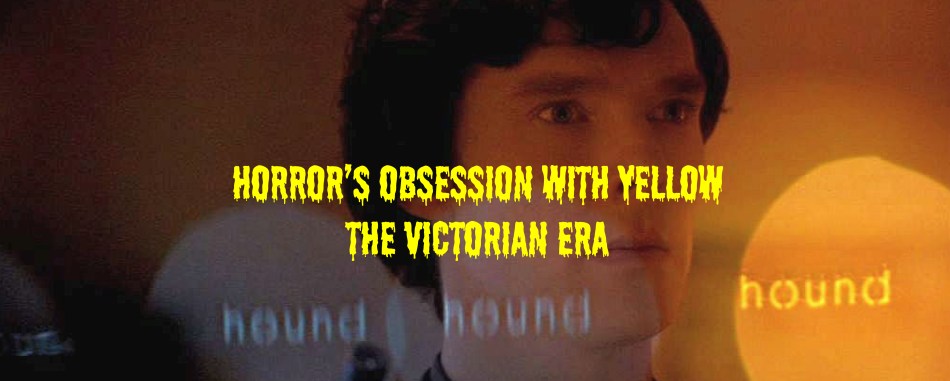
Within the facility where this drug and other science experiments are created, the lighting used is yellow much like in Doyle’s original story. In one particular scene where Watson is exploring a lab and unaware his has been drugged, the light gives the room a sickly yellow glow signifying Watson’s inner turmoil and fear in the situation. It is the best use of color in this episode, especially when Sherlock is thinking out what is truly going on, yellow light behind him, as his thoughts formulate actual words on screen. The word hound becomes what puts this mystery together for the man.
If you haven’t checked out Sherlock – I think we all kind of forgot about it after Cumberbatch signed on to be Doctor Strange for Marvel and became too busy to keep making the show – I recommend it. It holds up against the many other iterations of the Sherlock cannon.
Many of the film adaptations of this story used yellow in their poster art, taking lead from the storytelling. I watched a couple iterations of this during my research, and while neither will be films I watch again, the poster art for them will stick with me.
Beyond Sherlock Holmes
Arthur Conan Doyle was a prolific writer who not only created a world where Sherlock Holmes and Watson exist to solve their mysteries, but also wrote 120 short stories outside of the world of Holmes. Some were adventurous in nature, others medical mysteries. They spanned horror, science fiction, and the supernatural. In fact, Arthur Conan Doyle has been credited with giving us the evil reanimated mummy trope, one that has been used continuously throughout cinema. Within the confines of the writing itself, the author uses several references to the color yellow including a yellow path that was barred with black shadows of elm trees, an old yellow papyrus scroll, and the coarse yellow bandages that the mummy itself was wrapped in. The narrator himself forces his neighbor to destroy the mummy, an ending that feels a bit rushed given the scope of terror the mummy put the protagonist through. Though the author is credited with giving us this fun trope within horror, the story has very few adaptations and really only had one modern direct adaptation which I couldn’t watch because Brit Box didn’t have it available on the United States. It starred Kit Harrington, so I’m a little bummed I couldn’t find it elsewhere.
Among his other short stories are The Captain of the Polestar which has distinct parallels to The Terror where a ship is trapped in the arctic and the crew is set upon by an evil presence. Though the two stories are not linked in any way and Polestar is drawn from Doyle’s own experiences aboard a ship, the similarities are great. The short story also reminded me of Frankenstein as that story too features a ship trapped in ice aboard a Victorian ship. Apparently, fear of being trapped in the ice fields of the unknown was what terrified people in the late 1800s.
Among the collection of short stories I picked up was Playing With Fire, the telling of a séance in the dark. Doyle uses a greenish-yellow light and a spirit voice from the medium to set the stage. By the time the strange light has turned from green to red, the group becomes frightened as a from emerges. One of the people present was, “as white as a corpse, jerking and twitching like an epileptic.” As I stated, Doyle was a believer in communicating with the dead through a medium, so his telling of a séance aligns with that belief. The story itself was certainly readable.
Penny Dreadful and that Season 1 Séance
Fun Fact: Chemist William Henry Perkin accidentally created the first synthetic purple dye whilst trying to create an anti-malarial medicine in 1856. The color, mauveine, was even worn by Queen Victoria at the International Exhibition in 1862.
In the show Penny Dreadful, much like Victorian era literature, purple was often used to show internal conflict or to show one’s ambiguous social standing. I like to believe that the show’s costume department put Eva Green’s Vanessa Ives in a purple dress during the second episode of season one for that very reason. She is attending a séance with Malcolm Murray and up until this point, no one really knew the depths of her inner turmoil.
The high society in the Victorian era loved their séances, but Vanessa seems skeptical. She meets Dorain Gray in this episode and he is quick to point out that she is the only woman in the room not wearing gloves, as the etiquette of high society dictated that being bare-handed was improper in public, especially at such an event. He also points out that she is an appraising person, her intelligence evident. Vanessa is a standout among the women in the room when she is the only one who doesn’t have to remove her gloves when the séance starts.
The lights are lowered leaving the yellow candlelight on the table to cast dancing shadows about the room whose walls are covered in red curtains. Madame Kali, who leads the séance and also turns out to be Evelyn Poole who leads a witch’s coven in season 2, gets more than she bargained for. Vanessa is suddenly possessed by the demon Amunet who mimics the voice of Mina, Murray’s missing daughter of whom he is still looking for. When Amunet subsides, and they believe it over, Vanessa starts growling and slams her hands upon the table, cracking the glass loudly. No, this is Lucifer possessing her. He calls out Malcolm Murray for having an affair with her mother and blames him for the death of Peter, his son.
The cinematography of this scene is beautifully terrifying as Vanessa climbs upon the table and begins speaking an ancient language, her body bent backwards unnaturally. The people in the room begin to scream. Vanessa storms out into the night in her purple dress, lit only by the yellow light of the gas lamps along the narrow streets of London. She finds a man who she up and decides to have sex with in an alleyway, something that Dorian witnesses. Instead of judging her for it, he is intrigued and spends the season pursuing a relationship with her.
The scene takes up about half of the episode and is one of the more memorable ones from the series. It sets up Vanessa’s possession and introduces us the Madame Kali who returns in season two. In my eyes, though, it really sets the series soundly in the Victorian era where the séance and the communication with the dead through a conduit had risen in popularity. Many had used this to make money off of high society by faking their way through such an event, but this séance was a terrifying one. I think Arthur Conan Doyle would have approved.
Discover more from Becky Tyler Art and Photography
Subscribe to get the latest posts sent to your email.




Chapter 26
Horror in Victorian Literature Part 7
I think the most surprising thing to come of my months long foray into Victorian era horror literature was finding out that Arthur Conan Doyle was a huge proponent of Spiritualism – the belief that the dead can communicate with the living through a conduit or medium. I’ll admit that, outside of Benedict Cumberbatch’s turn as Sherlock Holmes, I’ve never been much of a fan of the deer-stalking-hat wearing detective nor was I fully aware of the scope of gothic horror short stories that Arthur Conan Doyle wrote during his life. That’s my bad. I’ve fixed this blunder. I’m just sorry it took 46 years to do it.
The Hound of the Baskervilles
I have friends that love all things Sherlock Holmes. The books. The movies. The television shows. They soak it all up and even make podcasts about them. I, however, have really only watched the aforementioned television show and one of the two films starring Robert Downey Jr. as the titular character. It was working on this blog series that caused me to pick up what is probably the most well known Holmes story, The Hound of the Baskervilles.
If you’ve read any of my book reviews, you probably know that I don’t like Agatha Christie novels because she uses multitudes of dialogue to tell her mystery stories. The stories are great, the mysteries enjoyable. But the expositional dialogue? Not for me. The first half of Baskervilles is like that. Conversations give the background of what has transpired out on the Baskerville moor. So much dialogue. Once Watson takes a train out of London, however, the writing becomes less dialogue and more descriptive. More my cup of tea. A woman’s silhouette set against the yellow light behind her. Dark paneling glowed in golden morning sunlight. In the black distance, a yellow light shown. A dull moaning of autumn wind and the rustle of falling leaves. Darkness and fog over the moor. Arthur Conan Doyle’s descriptions of the area surrounding this mystery, including several references to yellow lighting, are what make this such a great read – at least once I made it past the pages of extended dialogue where Holmes arrogantly gave his opinions on what was transpiring.
I’m going to use the Sherlock adaptation starring Benedict Cumberbatch as an example of how this story has been adapted for television. While the modern retelling changes aspects of the story as the superstition surrounding the hound isn’t a man trying to scare off an heir, but a chemical weapon from a local military base administered through fog that causes people hallucinate a terrifying wolf creature instead of a regular dog.
Within the facility where this drug and other science experiments are created, the lighting used is yellow much like in Doyle’s original story. In one particular scene where Watson is exploring a lab and unaware his has been drugged, the light gives the room a sickly yellow glow signifying Watson’s inner turmoil and fear in the situation. It is the best use of color in this episode, especially when Sherlock is thinking out what is truly going on, yellow light behind him, as his thoughts formulate actual words on screen. The word hound becomes what puts this mystery together for the man.
If you haven’t checked out Sherlock – I think we all kind of forgot about it after Cumberbatch signed on to be Doctor Strange for Marvel and became too busy to keep making the show – I recommend it. It holds up against the many other iterations of the Sherlock cannon.
Many of the film adaptations of this story used yellow in their poster art, taking lead from the storytelling. I watched a couple iterations of this during my research, and while neither will be films I watch again, the poster art for them will stick with me.
Beyond Sherlock Holmes
Arthur Conan Doyle was a prolific writer who not only created a world where Sherlock Holmes and Watson exist to solve their mysteries, but also wrote 120 short stories outside of the world of Holmes. Some were adventurous in nature, others medical mysteries. They spanned horror, science fiction, and the supernatural. In fact, Arthur Conan Doyle has been credited with giving us the evil reanimated mummy trope, one that has been used continuously throughout cinema. Within the confines of the writing itself, the author uses several references to the color yellow including a yellow path that was barred with black shadows of elm trees, an old yellow papyrus scroll, and the coarse yellow bandages that the mummy itself was wrapped in. The narrator himself forces his neighbor to destroy the mummy, an ending that feels a bit rushed given the scope of terror the mummy put the protagonist through. Though the author is credited with giving us this fun trope within horror, the story has very few adaptations and really only had one modern direct adaptation which I couldn’t watch because Brit Box didn’t have it available on the United States. It starred Kit Harrington, so I’m a little bummed I couldn’t find it elsewhere.
Among his other short stories are The Captain of the Polestar which has distinct parallels to The Terror where a ship is trapped in the arctic and the crew is set upon by an evil presence. Though the two stories are not linked in any way and Polestar is drawn from Doyle’s own experiences aboard a ship, the similarities are great. The short story also reminded me of Frankenstein as that story too features a ship trapped in ice aboard a Victorian ship. Apparently, fear of being trapped in the ice fields of the unknown was what terrified people in the late 1800s.
Among the collection of short stories I picked up was Playing With Fire, the telling of a séance in the dark. Doyle uses a greenish-yellow light and a spirit voice from the medium to set the stage. By the time the strange light has turned from green to red, the group becomes frightened as a from emerges. One of the people present was, “as white as a corpse, jerking and twitching like an epileptic.” As I stated, Doyle was a believer in communicating with the dead through a medium, so his telling of a séance aligns with that belief. The story itself was certainly readable.
Penny Dreadful and that Season 1 Séance
Fun Fact: Chemist William Henry Perkin accidentally created the first synthetic purple dye whilst trying to create an anti-malarial medicine in 1856. The color, mauveine, was even worn by Queen Victoria at the International Exhibition in 1862.
In the show Penny Dreadful, much like Victorian era literature, purple was often used to show internal conflict or to show one’s ambiguous social standing. I like to believe that the show’s costume department put Eva Green’s Vanessa Ives in a purple dress during the second episode of season one for that very reason. She is attending a séance with Malcolm Murray and up until this point, no one really knew the depths of her inner turmoil.
The high society in the Victorian era loved their séances, but Vanessa seems skeptical. She meets Dorain Gray in this episode and he is quick to point out that she is the only woman in the room not wearing gloves, as the etiquette of high society dictated that being bare-handed was improper in public, especially at such an event. He also points out that she is an appraising person, her intelligence evident. Vanessa is a standout among the women in the room when she is the only one who doesn’t have to remove her gloves when the séance starts.
The lights are lowered leaving the yellow candlelight on the table to cast dancing shadows about the room whose walls are covered in red curtains. Madame Kali, who leads the séance and also turns out to be Evelyn Poole who leads a witch’s coven in season 2, gets more than she bargained for. Vanessa is suddenly possessed by the demon Amunet who mimics the voice of Mina, Murray’s missing daughter of whom he is still looking for. When Amunet subsides, and they believe it over, Vanessa starts growling and slams her hands upon the table, cracking the glass loudly. No, this is Lucifer possessing her. He calls out Malcolm Murray for having an affair with her mother and blames him for the death of Peter, his son.
The cinematography of this scene is beautifully terrifying as Vanessa climbs upon the table and begins speaking an ancient language, her body bent backwards unnaturally. The people in the room begin to scream. Vanessa storms out into the night in her purple dress, lit only by the yellow light of the gas lamps along the narrow streets of London. She finds a man who she up and decides to have sex with in an alleyway, something that Dorian witnesses. Instead of judging her for it, he is intrigued and spends the season pursuing a relationship with her.
The scene takes up about half of the episode and is one of the more memorable ones from the series. It sets up Vanessa’s possession and introduces us the Madame Kali who returns in season two. In my eyes, though, it really sets the series soundly in the Victorian era where the séance and the communication with the dead through a conduit had risen in popularity. Many had used this to make money off of high society by faking their way through such an event, but this séance was a terrifying one. I think Arthur Conan Doyle would have approved.
Discover more from Becky Tyler Art and Photography
Subscribe to get the latest posts sent to your email.
Share this: