Chapter 25 – Horror in Victorian Literature Part 6
Michael Kors famously said during episode of 6 of season 9 of Project Runway, “She looks like a Victorian cocktail waitress in Las Vegas.” As a fan of that show, this is probably my favorite Michael Kors quote. He also dismissed extreme and painfully uncomfortable garments by saying women who bleed for fashion are not normal. Women of the Victorian era would beg to differ as some were willing to risk illness or death when it came to certain colors of fabrics.
In 1856, William Henry Perkin accidentally invented a coal-tar synthetic dye that made purple fabrics affordable during the Victorian era. Aniline dyes created in laboratories unlocked magenta, royal blue, and brilliant yellows. Scheele’s Green and Paris Green were made using copper-arsenite pigments that often made the wearer ill because the dye contained arsenic. While some of these colors meant certain death if worn too long, they also carried deeper meanings in societal terms. Blues were associated with divinity, intelligence, and tenderness. Greens symbolized nature and youth, even the toxic dangerous ones. Yellows represented sunlight and hospitality.
Guillermo del Toro used many of these colors to his advantage when adapting Mary Shelley’s Frankenstein especially in regard to the female characters and set designs. It isn’t the first time he has made a horror film with such gothic sensibilities. Crimson Peak also featured styles from the Victorian era to tell its moody tale of twisted love. For today’s blog, I’m concentrating solely on his Frankenstein adaptation.
The Sets
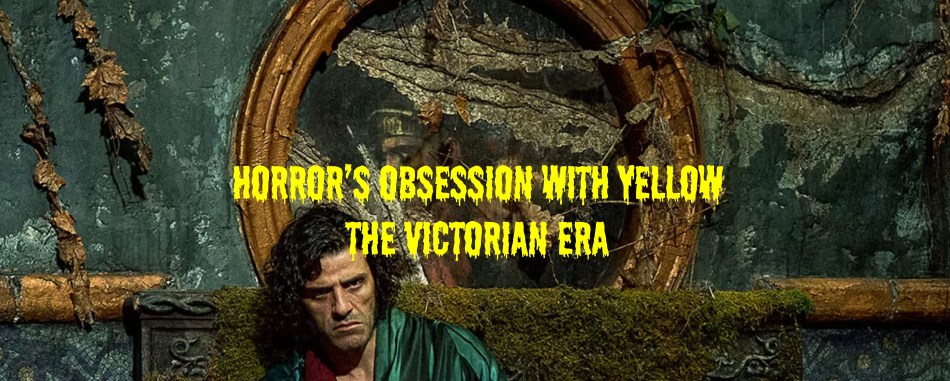
Victor Frankenstein manages to find an old Scottish gothic castle for the location of his laboratory. Within, he erects four large fuel cells that are green most of the time, but red when he is reanimating the corpse. Their design is a nod to the scientific and industrial revolutions that took place around the Victorian era and visually create a spectacle when the experiment is live. They also help fuel the fire that Victor sets after he deems the experiment a failure because he does not know how to be a father to the reanimated corpse who has the personality of a child. The other rooms in the castle show cracks in the walls with ivy and moss growing within each room and on some of the furniture. This, along with the green fuel cells in the lab, give kind of a sickly undertone to the entire place. A once grand castle now rotting both inside and out. Much like Victor, morally.
The ship in the arctic that serves as the set piece for both Victor and the Creature to tell each of their stories to the ship’s captain is lit only by candlelight and whatever natural light filters in from outside. This leaves the proceedings cast in light that is yellow and green. It is a story about the monsters within each of us, after all, so del Toro knowingly using this lighting is perfect for setting that stage.
The Wardrobes
In 1848, Almond D. Fisk patented a metallic burial case with a glass panel over the face. This coffin was meant to prevent grave robbing and was something only the rich could afford. Guillermo del Toro used this type of coffin when burying Victor’s mother. The gothic aesthetic of the coffin, stark white with red surrounding the face, fit perfectly within the context of the film and set it firmly in the Victorian era. Red tells the story of emotion – the grief that Victor had at losing her. It tells the story of the family’s social standing as it was a bold, powerful color. When alive, she wore red dresses showing her vitality and warmth. The life’s blood to Victor since he received no tenderness or love from his father in this adaptation.
Makeup served an important role in this film when it came to Mia Goth who played both Victor Frankenstein’s mother and Lady Elizabeth Harlander, the fiancée to Victor’s brother, William. Goth has naturally barely there eyebrows, but simply adding darker eyebrows and some contouring on her cheekbones made her unrecognizable during my first viewing of this film. I didn’t realize Mia Goth was also the mother until afterwards when I read it online because having darker eyebrows changed her look entirely.
Elizabeth’s character was ahead of her time in this adaptation much in the way that Mary Shelley was ahead of her time. She is intelligent and empathetic with a natural curiosity for the scientific world. She has an affinity for bugs and instantly strikes up a friendship with the Creature when she meets him. Unlike Victor, she sees his humanity and his childlike curiosity instead of a dumb, walking corpse. Elizabeth wears several dresses that are bright jewel tones that are ornately decorated and embroidered. Her blue dress symbolized her intelligence during her and Victor’s first meeting as she engages in scientific discussion with him. The costume even incorporates blue feathers in her headpiece, a direct nod to the Aesthetic Movement that I talked about in Chapter 22 of this blog series.
Her yellow dress, the one she wears when she and Victor talk outside and she is catching bugs with a matching net, shows her as the light in Victor’s life. He falls in love with her even though she is betrothed to his brother. He sees the future, and at is bright with the light that Elizabeth emulates. The light of the sun.
Elizabeth’s green dresses mimic the colors and shapes of the insects that she so clearly loves and sees the beauty in. The shiny, metallic shells of beetles come to mind when I see her wearing them. The colors also show her youthful, nurturing personality as she befriends the Creature. It is also in one of those dresses that she finally sees Victor for what he is. She sees the cruel, selfishly blind man who abused his own creation. This woman who loves all living things can never love a man who has no fatherly affection within him.
If you’re a fan of the old Universal monster movies, then you’ve seen The Bride of Frankenstein. That version of the bride does not actually exist in the book in the way it was depicted back in the 1930s. Universal created one of the most iconic monsters in cinema – and then never used her again. Guillermo del Toro’s costume department incorporated the mummy cloth design used to wrap Elsa Lanchester’s arms in The Bride of Frankenstein into Mia Goth’s wedding dress. While they used silks instead of whatever muslin was used in the older film, Goth’s dress is the perfect modern update to one of the most iconic looks in horror film history. The white dress also shows the red blood from her gunshot wound and we know she isn’t going to survive. Her death sends Victor chasing the Creature into the frozen wilderness until they end up at the very ship where they tell their stories.
The Creature
Mary Shelley described the creature as about eight feet tall and assembled from several different corpses. His appearance was meant to be unnatural and grotesque in stark contrast with his personality. In this adaptation, the Creature has both blue and yellow toned skin, the scarring a relic from the corpses Victor used to create him which shows the viewer how Victor sees his own creation. As pieces taken from other parts, not as a whole person which is exactly how Victor views his experiment. Pieces. Victor’s immediate reaction is fear when he realizes the Creature is alive and he chains him up below the castle. After the Creature escapes the fire set by Victor, he finds himself in a forest. When hunters happen upon him, they too try to kill him for all they see is a monster. It takes a blind man to truly give the Creature the love and friendship he so desperately seeks.
The Creature goes from mostly naked except for the few bandages left from his procedure in earlier scenes to slowly acquiring clothing. By the time he finds his way back to Victor, he is clothed in a heavy cloak made of various furs and animal skins. This shows his growth from childlike to something closer to an adult and also symbolizes how he has learned to hate Victor for creating him and leaving him alone in a cruel world. The more his costume begins to look like a monster, the more animalistic the rage he feels. A very intentional progression.
As far as Frankenstein adaptations and Victorian era films in general, it does not get much better than this one. The use of color and set design, of makeup and music, make for a heartbreaking tale of loneliness and forgiveness that will remain unmatched for me for quite some time. If you haven’t watched this version, it is currently streaming on Netfilx and will be released for the first time on physical media through the Criterion Collection on October, 26, 2026. I’m segueing to literature’s most famous mystery solvers next. I hope you bring the right hat.
Discover more from Becky Tyler Art and Photography
Subscribe to get the latest posts sent to your email.




Chapter 25 – Horror in Victorian Literature Part 6
Michael Kors famously said during episode of 6 of season 9 of Project Runway, “She looks like a Victorian cocktail waitress in Las Vegas.” As a fan of that show, this is probably my favorite Michael Kors quote. He also dismissed extreme and painfully uncomfortable garments by saying women who bleed for fashion are not normal. Women of the Victorian era would beg to differ as some were willing to risk illness or death when it came to certain colors of fabrics.
In 1856, William Henry Perkin accidentally invented a coal-tar synthetic dye that made purple fabrics affordable during the Victorian era. Aniline dyes created in laboratories unlocked magenta, royal blue, and brilliant yellows. Scheele’s Green and Paris Green were made using copper-arsenite pigments that often made the wearer ill because the dye contained arsenic. While some of these colors meant certain death if worn too long, they also carried deeper meanings in societal terms. Blues were associated with divinity, intelligence, and tenderness. Greens symbolized nature and youth, even the toxic dangerous ones. Yellows represented sunlight and hospitality.
Guillermo del Toro used many of these colors to his advantage when adapting Mary Shelley’s Frankenstein especially in regard to the female characters and set designs. It isn’t the first time he has made a horror film with such gothic sensibilities. Crimson Peak also featured styles from the Victorian era to tell its moody tale of twisted love. For today’s blog, I’m concentrating solely on his Frankenstein adaptation.
The Sets
Victor Frankenstein manages to find an old Scottish gothic castle for the location of his laboratory. Within, he erects four large fuel cells that are green most of the time, but red when he is reanimating the corpse. Their design is a nod to the scientific and industrial revolutions that took place around the Victorian era and visually create a spectacle when the experiment is live. They also help fuel the fire that Victor sets after he deems the experiment a failure because he does not know how to be a father to the reanimated corpse who has the personality of a child. The other rooms in the castle show cracks in the walls with ivy and moss growing within each room and on some of the furniture. This, along with the green fuel cells in the lab, give kind of a sickly undertone to the entire place. A once grand castle now rotting both inside and out. Much like Victor, morally.
The ship in the arctic that serves as the set piece for both Victor and the Creature to tell each of their stories to the ship’s captain is lit only by candlelight and whatever natural light filters in from outside. This leaves the proceedings cast in light that is yellow and green. It is a story about the monsters within each of us, after all, so del Toro knowingly using this lighting is perfect for setting that stage.
The Wardrobes
In 1848, Almond D. Fisk patented a metallic burial case with a glass panel over the face. This coffin was meant to prevent grave robbing and was something only the rich could afford. Guillermo del Toro used this type of coffin when burying Victor’s mother. The gothic aesthetic of the coffin, stark white with red surrounding the face, fit perfectly within the context of the film and set it firmly in the Victorian era. Red tells the story of emotion – the grief that Victor had at losing her. It tells the story of the family’s social standing as it was a bold, powerful color. When alive, she wore red dresses showing her vitality and warmth. The life’s blood to Victor since he received no tenderness or love from his father in this adaptation.
Makeup served an important role in this film when it came to Mia Goth who played both Victor Frankenstein’s mother and Lady Elizabeth Harlander, the fiancée to Victor’s brother, William. Goth has naturally barely there eyebrows, but simply adding darker eyebrows and some contouring on her cheekbones made her unrecognizable during my first viewing of this film. I didn’t realize Mia Goth was also the mother until afterwards when I read it online because having darker eyebrows changed her look entirely.
Elizabeth’s character was ahead of her time in this adaptation much in the way that Mary Shelley was ahead of her time. She is intelligent and empathetic with a natural curiosity for the scientific world. She has an affinity for bugs and instantly strikes up a friendship with the Creature when she meets him. Unlike Victor, she sees his humanity and his childlike curiosity instead of a dumb, walking corpse. Elizabeth wears several dresses that are bright jewel tones that are ornately decorated and embroidered. Her blue dress symbolized her intelligence during her and Victor’s first meeting as she engages in scientific discussion with him. The costume even incorporates blue feathers in her headpiece, a direct nod to the Aesthetic Movement that I talked about in Chapter 22 of this blog series.
Her yellow dress, the one she wears when she and Victor talk outside and she is catching bugs with a matching net, shows her as the light in Victor’s life. He falls in love with her even though she is betrothed to his brother. He sees the future, and at is bright with the light that Elizabeth emulates. The light of the sun.
Elizabeth’s green dresses mimic the colors and shapes of the insects that she so clearly loves and sees the beauty in. The shiny, metallic shells of beetles come to mind when I see her wearing them. The colors also show her youthful, nurturing personality as she befriends the Creature. It is also in one of those dresses that she finally sees Victor for what he is. She sees the cruel, selfishly blind man who abused his own creation. This woman who loves all living things can never love a man who has no fatherly affection within him.
If you’re a fan of the old Universal monster movies, then you’ve seen The Bride of Frankenstein. That version of the bride does not actually exist in the book in the way it was depicted back in the 1930s. Universal created one of the most iconic monsters in cinema – and then never used her again. Guillermo del Toro’s costume department incorporated the mummy cloth design used to wrap Elsa Lanchester’s arms in The Bride of Frankenstein into Mia Goth’s wedding dress. While they used silks instead of whatever muslin was used in the older film, Goth’s dress is the perfect modern update to one of the most iconic looks in horror film history. The white dress also shows the red blood from her gunshot wound and we know she isn’t going to survive. Her death sends Victor chasing the Creature into the frozen wilderness until they end up at the very ship where they tell their stories.
The Creature
Mary Shelley described the creature as about eight feet tall and assembled from several different corpses. His appearance was meant to be unnatural and grotesque in stark contrast with his personality. In this adaptation, the Creature has both blue and yellow toned skin, the scarring a relic from the corpses Victor used to create him which shows the viewer how Victor sees his own creation. As pieces taken from other parts, not as a whole person which is exactly how Victor views his experiment. Pieces. Victor’s immediate reaction is fear when he realizes the Creature is alive and he chains him up below the castle. After the Creature escapes the fire set by Victor, he finds himself in a forest. When hunters happen upon him, they too try to kill him for all they see is a monster. It takes a blind man to truly give the Creature the love and friendship he so desperately seeks.
The Creature goes from mostly naked except for the few bandages left from his procedure in earlier scenes to slowly acquiring clothing. By the time he finds his way back to Victor, he is clothed in a heavy cloak made of various furs and animal skins. This shows his growth from childlike to something closer to an adult and also symbolizes how he has learned to hate Victor for creating him and leaving him alone in a cruel world. The more his costume begins to look like a monster, the more animalistic the rage he feels. A very intentional progression.
As far as Frankenstein adaptations and Victorian era films in general, it does not get much better than this one. The use of color and set design, of makeup and music, make for a heartbreaking tale of loneliness and forgiveness that will remain unmatched for me for quite some time. If you haven’t watched this version, it is currently streaming on Netfilx and will be released for the first time on physical media through the Criterion Collection on October, 26, 2026. I’m segueing to literature’s most famous mystery solvers next. I hope you bring the right hat.
Discover more from Becky Tyler Art and Photography
Subscribe to get the latest posts sent to your email.
Share this: