Ethan Hawke and Russel Crowe star alongside Avi Nash, Julia Jones, and Austin Amelio in a film about Samual Murphy (Hawke), a man who is sent to a hard labor camp for supposedly trying to break into building when he was just trying to find a new apartment for he and his daughter. When the operator of the labor camp, J.J. Clancy (Crowe) wants to move the gold from his nearby mine before FDR can commandeer it for the Government (it was the Great Depression), he promises Samual an early release to do it for him so the man can collect his daughter before she becomes a ward of the state and gets adopted by someone else.
The group of four labor camp workers, one Native American woman, and two men who work for the mine have five days to carry heavy bags of gold through the wilderness. Each has their own reasons for taking the early release for such a dangerous trip because not only do they have the elements to deal with, but other mine owners are looking to steal their gold.
What makes Samual such a great character is that he is so intelligent. He can fix just about anything and when motivated, can work his way out of any issue which includes moving a gigantic boulder off the road the labor camp workers are building. He also can spot a bull shitter a mile away. This intelligence is also what makes certain people hate him. They can’t manipulate him, and that puts him in danger when put in certain situations. Like carrying gold for men who intend to kill him once the gold gets where it needs to be. Man vs. man is as ever present as the man vs. nature themes in this film.
As the title implies, it has double meanings. The weight of the gold is heavy, sure, but so is the weight of the Great Depression. Of poverty. Of just trying to get your kid back and knowing if you don’t, you’ve broken every promise you ever made to her. Of protecting those around you against rich oppressors. The weight of the world on their shoulders is as heavy as any gold. Even the way the film is shot with large sweeping shots of the Oregon Pacific Northwest setting juxtaposed with closeups of characters during stressful scenes shows that to the characters, what truly matters is surviving the things that are out of their control. One scene amplifies this as they must throw bricks of gold one at a time across a rotting rope bridge. Samual is in the middle trying not to drop the bricks or dry in the process.
Cinematography elevates the film to something that is both intimate and beautiful. The wilderness is its own character, one that has its own plan. Though the film was shot in Germany for financial reasons, the Oregon setting offers up the rain and damp the region is known for as well as some brilliant fog that mirrors the murky ambiguity between right and wrong that the film offers up. One scene in particular takes place during a thunderstorm in the dead of night and the viewer can only see what happens when the lightning flashes. That scene changes the course of events in the film, and the use of both the dark of night and the lightning is a work a art.
Highly recommend this film for the way it is filmed and for the film’s performances.
4.5 out of 5 stars.
Discover more from Becky Tyler Art and Photography
Subscribe to get the latest posts sent to your email.


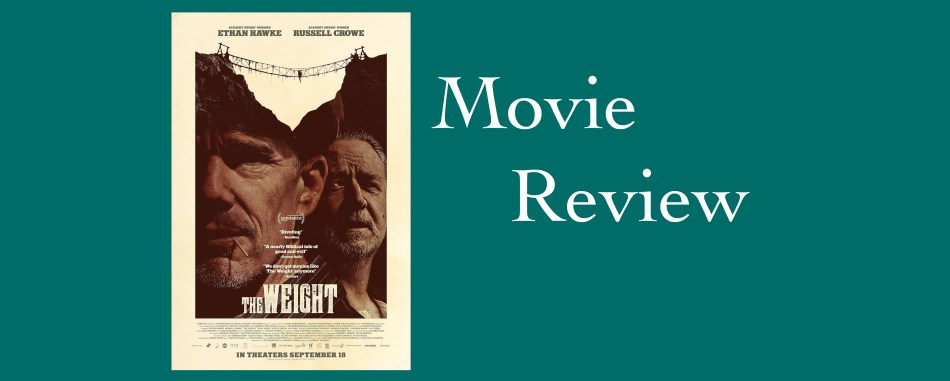


Ethan Hawke and Russel Crowe star alongside Avi Nash, Julia Jones, and Austin Amelio in a film about Samual Murphy (Hawke), a man who is sent to a hard labor camp for supposedly trying to break into building when he was just trying to find a new apartment for he and his daughter. When the operator of the labor camp, J.J. Clancy (Crowe) wants to move the gold from his nearby mine before FDR can commandeer it for the Government (it was the Great Depression), he promises Samual an early release to do it for him so the man can collect his daughter before she becomes a ward of the state and gets adopted by someone else.
The group of four labor camp workers, one Native American woman, and two men who work for the mine have five days to carry heavy bags of gold through the wilderness. Each has their own reasons for taking the early release for such a dangerous trip because not only do they have the elements to deal with, but other mine owners are looking to steal their gold.
What makes Samual such a great character is that he is so intelligent. He can fix just about anything and when motivated, can work his way out of any issue which includes moving a gigantic boulder off the road the labor camp workers are building. He also can spot a bull shitter a mile away. This intelligence is also what makes certain people hate him. They can’t manipulate him, and that puts him in danger when put in certain situations. Like carrying gold for men who intend to kill him once the gold gets where it needs to be. Man vs. man is as ever present as the man vs. nature themes in this film.
As the title implies, it has double meanings. The weight of the gold is heavy, sure, but so is the weight of the Great Depression. Of poverty. Of just trying to get your kid back and knowing if you don’t, you’ve broken every promise you ever made to her. Of protecting those around you against rich oppressors. The weight of the world on their shoulders is as heavy as any gold. Even the way the film is shot with large sweeping shots of the Oregon Pacific Northwest setting juxtaposed with closeups of characters during stressful scenes shows that to the characters, what truly matters is surviving the things that are out of their control. One scene amplifies this as they must throw bricks of gold one at a time across a rotting rope bridge. Samual is in the middle trying not to drop the bricks or dry in the process.
Cinematography elevates the film to something that is both intimate and beautiful. The wilderness is its own character, one that has its own plan. Though the film was shot in Germany for financial reasons, the Oregon setting offers up the rain and damp the region is known for as well as some brilliant fog that mirrors the murky ambiguity between right and wrong that the film offers up. One scene in particular takes place during a thunderstorm in the dead of night and the viewer can only see what happens when the lightning flashes. That scene changes the course of events in the film, and the use of both the dark of night and the lightning is a work a art.
Highly recommend this film for the way it is filmed and for the film’s performances.
4.5 out of 5 stars.
Discover more from Becky Tyler Art and Photography
Subscribe to get the latest posts sent to your email.
Share this: