Chapter 20 – Horror in Victorian Literature Part 1
Ah, autumn. That time of year when the leaves change colors and the air cools. Pumpkin patches build corn mazes for the kids to enjoy. Strands of orange lights decorate porches. And horror loving folks like myself watch every horror movie they can get their hands on. Some of us even carve turnips, a pagan tradition that started in Ireland. Next door, England became the birthplace of Gothic horror which started during the Victorian era and that, Boys and Ghouls, is the subject of my Yellow in Horror series this October. From the Penny Dreadfuls to gothic horror novels, the Victorian Era inspired film and television adaptations since the beginning of cinema during the silent era. One television show in particular took several inspirations from the era and created a three season effort that not only utilized color to tell its gothic tale but also left an impact on how horror is portrayed on television that isn’t talked about enough. That show was Penny Dreadful which ran on Showtime between 2016 and 2018. I’ll make comparisons between the show and the literature it was based on as well as film adaptations that have been made over the years throughout this blog series. Stay with me. It’s going to be a bloody good time.
Today, I’m talking specifically about how Penny Dreadfuls proliferated across England during the Victorian era. Just for some context, the Georgian era (in Britian) lasted until 1837 King William IV passed away. Queen Victoria would ascend the throne ushering in the Victorian era that lasted until her death in 1901. In the United States, this time period saw two industrial revolutions that were bookends to the Civil War. While the Victorian influences spread to the United States during that time, I’ll be concentrating on Victorian era London and England for this year’s blog series with one noted foray into Paris along the way.
Stories known Penny Dreadfuls quickly became a popular pass time in the mid 1800s. A better educational system meant more people were literate whilst the rise of capitalism and industrialism meant working people had a bit more money to spend on non-essentials like entertainment. By 1836, printing presses and rail systems also saw improvements making it easier to distribute the eight to sixteen page pamphlets the first penny dreadfuls were printed on. By 1850, over 100 publishers were printing penny fiction which was also known as Penny Awfuls and Penny Bloods. The serials were marketed to young men and boys who loved gothic crime and horror stories. Apparently, the modern girls-don’t-like-horror assumption is deeply rooted in the past. **rolls eyes at patriarchy**
Thanks to these pamphlets, we have stories about Sweeney Todd: The Demon Barber of Fleet Street and Varney the Vampire. Illustration became a large part of these pamphlets giving a visual to go along with the written word. American stories about Buffalo Bill and Deadwood Dick were rewritten and marketed to British boys for the Wild Wild West was very marketable, even then.
By the 1890s, new competition from the first comic pages ushered in the decline of the penny dreadful. The popularization of the novel also contributed to the multitudes of people who took up reading, but it was the Penny Dreadful that paved the way for modern day comic books as we know them as well as the pulp magazines that remained popular through the 1950s.
Sweeney Todd: The Most Famous Penny Dreadful
Published as a serialized story in 1846 and originally titled The String of Pearls, the story of Sweeney Todd was far more generic than how we know the character today. While there is no evidence that such a person existed in Victorian era London, the character became part of the city’s lore. The People’s Periodical and Family Library published the story in 18 parts. Both James Malcolm Rymer and Thomas Peckett Prest have been credited with writing it, but history isn’t very clear on that tidbit. Before the 18-week story was even finished, George Dipdin Pitt adapted it for the Britannia Theatre in east London. It was in this play that Todd started using the catchphrase, “I’ll finish him off.” In 1850, it was published as a book with the subtitle ‘The Demon Barber of Fleet Street. A Domestic Romance.’ A plagiarized version was printed in the United States as Sweeney Todd: or the Ruffian Barber. It was also expanded into a longer serialized version which is where the first claim that Sweeney Todd was a real person was made.
Beyond that first stage production in 1846, theatres adapted the story again in 1865, but there was a long gap before the next theater production. In 1962, it was adapted to a four-part play that included new songs and lyrics. In 1973, British playwright Christopher Bond gave Sweeney Todd a sympathetic backstory that included losing his wife and child when he was falsely accused of a crime and sent to a penal colony. This was the first iteration of the story that saw the character’s violent nature brought out of revenge. The subplot with Mrs. Lovett and her meat pies remains, but now she knew that the wife and daughter were still alive and kept it from Todd.
Film productions included a 1926 silent film that was fifteen minutes long and a 1928 version which is the earliest surviving film production of Sweeney Todd. In 1936, Sweeney Todd: The Demon Barber of Fleet Street starred Tod Slaughter and Stella Rho. Under the name Bloodthirsty Butchers, it was also adapted for film again in 1970. Made for TV movies proliferated throughout the years after 1970.
I’ve stated previously that Penny Dreadfuls are credited as being the precursor to the comic book boom in the 20th century. This specific story is no exception. Marc Andreyko’s Manhunter series featured Todd as a ghost who possesses men. UK publisher Classical Comics created graphic novel adaptations and a full color paper book in 2010.
It was in 1979 that the official musical adaptation of the story by Stephen Sondheim and Hugh Wheeler began on Broadway. This production won a Tony Award for Best Musical and has had several revivals over the years. For modern audiences, the musical was adapted into the 2007 Tim Burton movie of the same name. This is the version I’m talking about today. The NBC sitcom The Office also had an episode that included a Scranton version of the play, music included. It’s one of my favorite episodes.
More specifically, I’m discussing how the film used color. Tim Burton is known for his color pallets in movies. He often juxtaposes one dark, muted pallet of one place with bright, vibrant colors of another. Edward Scissorhands and The Nightmare Before Christmas are two great examples. His adaptation of Sweeney Todd is no different. The London that Benjamin Barker a.k.a. Sweeney Todd remembers is far different than the gothic, moody London he returns to. This shows how much of his grief and anger affect his view of the world at large, but especially the place where he lost his wife and child.
His wife and daughter in flashback scenes are dressed in whites and ivory showing their innocence. Their happiness in the sunlight, pristine and perfectly unaffected by all the wrongs in the world. Even as they walk through a display of flowers as a family at a crowded market, sunlight makes the scene bright. That is all undone when Todd is taken by police for some unknown crime and Judge Turpin (Alan Rickman) appears at the side of the wife and daughter. Turpin’s suit is red in this scene. The devil’s color. The color of blood. That’s no coincidence. It stands out as the evil presence in their lives from that point forward even when Turpin’s clothing is black later on.
Mrs. Lovett dresses in dark maroons and blacks with lacy accents. Her hair is varying degrees of messy showing the instability of her personality. She might have maternal instincts toward Toby, the boy she and Todd take in later in the film, but she lies to Todd about the death of his wife and daughter. In a fantasy sequence when she sings about having some kind of future with Todd, the skies are blue and the sun shines upon them at the beach. It is such a far-flung hope that the viewer knows will never come true.
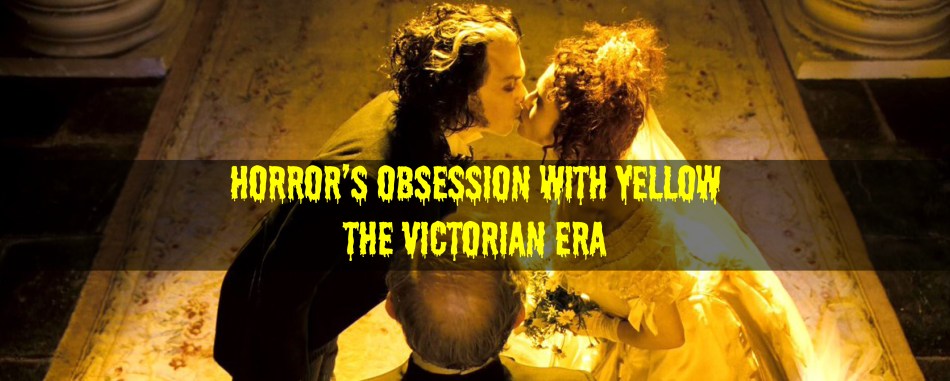
When she finally gets to the wedding portion of this fantasy, the entire room is yellow from the sun coming through a stained-glass window. Even her dress looks infected by this ill looking light. A sickly yellow showing their moral decay.
Todd had a travel companion with him when he arrived in London. Anthony Hope is his name, and this young man somehow manages to find the prettiest girl in all of London. Judge Turpin’s ward, who also happens to be Johanna, Todd’s daughter he thinks is dead. Johanna too is always dressed in pretty dresses showing the lifestyle that Turpin afforded her as he waits for her to come of age so he can marry her. It is her yellow hair that Anthony Hope sings about. The blondest of hair, showing her innocence.
As Sweeney Todd goes about his throat slitting and Mrs. Lovett makes her meat pies with the bodies, Anthony hatches a plan to get Johanna out of Turpin’s house so they can run away together. All the while, Todd’s wife is wandering the streets with a scarred face singing about how she knows something evil is brewing at Mrs. Lovett’s Meat Pies. In a morbid turn of events that only gothic horror could do, Todd kills the wife he doesn’t recognize because he is too blinded by his hate and revenge to see who she is. He doesn’t recognize his own daughter either but lets her escape. In the end, it is both Todd and Mrs. Lovett who pay the price for the evil deeds. Mrs. Lovett’s death in particular is symbolic of burning in hell after Todd throws her in the boiler.
I like to believe the lingering interest in Sweeney Todd has to do with it being so deeply engrained in Victorian era London culture as we view it today. Even with no proof that this serial killer existed, people keep adapting the story. Like Jack the Ripper and Spring Heeled Jack, rumor and myth were exasperated by sensational reporting of newspapers. The name for this was yellow journalism (Ha! Yellow!), a term coined in the 1890s. This type of “news” amplified city rumors, gruesome crimes, false news, and social scandals for the purpose of captivating audiences so they buy more papers. Sound familiar? Today we call that clickbait.
That will be my subject in my next blog as I talk about Jack the Ripper. After that, I’ll start getting into how real life and folklore serial killers alike helped bring the show Penny Dreadful to life in the modern era.
Discover more from Becky Tyler Art and Photography
Subscribe to get the latest posts sent to your email.


 Becky Tyler Art and Photography
Chapter 20 – Horror in Victorian Literature Part 1
Ah, autumn. That time of year when the leaves change colors and the air cools. Pumpkin patches build corn mazes for the kids to enjoy. Strands of orange lights decorate porches. And horror loving folks like myself watch every horror movie they can get their hands on. Some of us even carve turnips, a pagan tradition that started in Ireland. Next door, England became the birthplace of Gothic horror which started during the Victorian era and that, Boys and Ghouls, is the subject of my Yellow in Horror series this October. From the Penny Dreadfuls to gothic horror novels, the Victorian Era inspired film and television adaptations since the beginning of cinema during the silent era. One television show in particular took several inspirations from the era and created a three season effort that not only utilized color to tell its gothic tale but also left an impact on how horror is portrayed on television that isn’t talked about enough. That show was Penny Dreadful which ran on Showtime between 2016 and 2018. I’ll make comparisons between the show and the literature it was based on as well as film adaptations that have been made over the years throughout this blog series. Stay with me. It’s going to be a bloody good time.
Today, I’m talking specifically about how Penny Dreadfuls proliferated across England during the Victorian era. Just for some context, the Georgian era (in Britian) lasted until 1837 King William IV passed away. Queen Victoria would ascend the throne ushering in the Victorian era that lasted until her death in 1901. In the United States, this time period saw two industrial revolutions that were bookends to the Civil War. While the Victorian influences spread to the United States during that time, I’ll be concentrating on Victorian era London and England for this year’s blog series with one noted foray into Paris along the way.
Stories known Penny Dreadfuls quickly became a popular pass time in the mid 1800s. A better educational system meant more people were literate whilst the rise of capitalism and industrialism meant working people had a bit more money to spend on non-essentials like entertainment. By 1836, printing presses and rail systems also saw improvements making it easier to distribute the eight to sixteen page pamphlets the first penny dreadfuls were printed on. By 1850, over 100 publishers were printing penny fiction which was also known as Penny Awfuls and Penny Bloods. The serials were marketed to young men and boys who loved gothic crime and horror stories. Apparently, the modern girls-don’t-like-horror assumption is deeply rooted in the past. **rolls eyes at patriarchy**
Thanks to these pamphlets, we have stories about Sweeney Todd: The Demon Barber of Fleet Street and Varney the Vampire. Illustration became a large part of these pamphlets giving a visual to go along with the written word. American stories about Buffalo Bill and Deadwood Dick were rewritten and marketed to British boys for the Wild Wild West was very marketable, even then.
By the 1890s, new competition from the first comic pages ushered in the decline of the penny dreadful. The popularization of the novel also contributed to the multitudes of people who took up reading, but it was the Penny Dreadful that paved the way for modern day comic books as we know them as well as the pulp magazines that remained popular through the 1950s.
Sweeney Todd: The Most Famous Penny Dreadful
Published as a serialized story in 1846 and originally titled The String of Pearls, the story of Sweeney Todd was far more generic than how we know the character today. While there is no evidence that such a person existed in Victorian era London, the character became part of the city’s lore. The People’s Periodical and Family Library published the story in 18 parts. Both James Malcolm Rymer and Thomas Peckett Prest have been credited with writing it, but history isn’t very clear on that tidbit. Before the 18-week story was even finished, George Dipdin Pitt adapted it for the Britannia Theatre in east London. It was in this play that Todd started using the catchphrase, “I’ll finish him off.” In 1850, it was published as a book with the subtitle ‘The Demon Barber of Fleet Street. A Domestic Romance.’ A plagiarized version was printed in the United States as Sweeney Todd: or the Ruffian Barber. It was also expanded into a longer serialized version which is where the first claim that Sweeney Todd was a real person was made.
Beyond that first stage production in 1846, theatres adapted the story again in 1865, but there was a long gap before the next theater production. In 1962, it was adapted to a four-part play that included new songs and lyrics. In 1973, British playwright Christopher Bond gave Sweeney Todd a sympathetic backstory that included losing his wife and child when he was falsely accused of a crime and sent to a penal colony. This was the first iteration of the story that saw the character’s violent nature brought out of revenge. The subplot with Mrs. Lovett and her meat pies remains, but now she knew that the wife and daughter were still alive and kept it from Todd.
Film productions included a 1926 silent film that was fifteen minutes long and a 1928 version which is the earliest surviving film production of Sweeney Todd. In 1936, Sweeney Todd: The Demon Barber of Fleet Street starred Tod Slaughter and Stella Rho. Under the name Bloodthirsty Butchers, it was also adapted for film again in 1970. Made for TV movies proliferated throughout the years after 1970.
I’ve stated previously that Penny Dreadfuls are credited as being the precursor to the comic book boom in the 20th century. This specific story is no exception. Marc Andreyko’s Manhunter series featured Todd as a ghost who possesses men. UK publisher Classical Comics created graphic novel adaptations and a full color paper book in 2010.
It was in 1979 that the official musical adaptation of the story by Stephen Sondheim and Hugh Wheeler began on Broadway. This production won a Tony Award for Best Musical and has had several revivals over the years. For modern audiences, the musical was adapted into the 2007 Tim Burton movie of the same name. This is the version I’m talking about today. The NBC sitcom The Office also had an episode that included a Scranton version of the play, music included. It’s one of my favorite episodes.
More specifically, I’m discussing how the film used color. Tim Burton is known for his color pallets in movies. He often juxtaposes one dark, muted pallet of one place with bright, vibrant colors of another. Edward Scissorhands and The Nightmare Before Christmas are two great examples. His adaptation of Sweeney Todd is no different. The London that Benjamin Barker a.k.a. Sweeney Todd remembers is far different than the gothic, moody London he returns to. This shows how much of his grief and anger affect his view of the world at large, but especially the place where he lost his wife and child.
His wife and daughter in flashback scenes are dressed in whites and ivory showing their innocence. Their happiness in the sunlight, pristine and perfectly unaffected by all the wrongs in the world. Even as they walk through a display of flowers as a family at a crowded market, sunlight makes the scene bright. That is all undone when Todd is taken by police for some unknown crime and Judge Turpin (Alan Rickman) appears at the side of the wife and daughter. Turpin’s suit is red in this scene. The devil’s color. The color of blood. That’s no coincidence. It stands out as the evil presence in their lives from that point forward even when Turpin’s clothing is black later on.
Mrs. Lovett dresses in dark maroons and blacks with lacy accents. Her hair is varying degrees of messy showing the instability of her personality. She might have maternal instincts toward Toby, the boy she and Todd take in later in the film, but she lies to Todd about the death of his wife and daughter. In a fantasy sequence when she sings about having some kind of future with Todd, the skies are blue and the sun shines upon them at the beach. It is such a far-flung hope that the viewer knows will never come true.
When she finally gets to the wedding portion of this fantasy, the entire room is yellow from the sun coming through a stained-glass window. Even her dress looks infected by this ill looking light. A sickly yellow showing their moral decay.
Todd had a travel companion with him when he arrived in London. Anthony Hope is his name, and this young man somehow manages to find the prettiest girl in all of London. Judge Turpin’s ward, who also happens to be Johanna, Todd’s daughter he thinks is dead. Johanna too is always dressed in pretty dresses showing the lifestyle that Turpin afforded her as he waits for her to come of age so he can marry her. It is her yellow hair that Anthony Hope sings about. The blondest of hair, showing her innocence.
As Sweeney Todd goes about his throat slitting and Mrs. Lovett makes her meat pies with the bodies, Anthony hatches a plan to get Johanna out of Turpin’s house so they can run away together. All the while, Todd’s wife is wandering the streets with a scarred face singing about how she knows something evil is brewing at Mrs. Lovett’s Meat Pies. In a morbid turn of events that only gothic horror could do, Todd kills the wife he doesn’t recognize because he is too blinded by his hate and revenge to see who she is. He doesn’t recognize his own daughter either but lets her escape. In the end, it is both Todd and Mrs. Lovett who pay the price for the evil deeds. Mrs. Lovett’s death in particular is symbolic of burning in hell after Todd throws her in the boiler.
I like to believe the lingering interest in Sweeney Todd has to do with it being so deeply engrained in Victorian era London culture as we view it today. Even with no proof that this serial killer existed, people keep adapting the story. Like Jack the Ripper and Spring Heeled Jack, rumor and myth were exasperated by sensational reporting of newspapers. The name for this was yellow journalism (Ha! Yellow!), a term coined in the 1890s. This type of “news” amplified city rumors, gruesome crimes, false news, and social scandals for the purpose of captivating audiences so they buy more papers. Sound familiar? Today we call that clickbait.
That will be my subject in my next blog as I talk about Jack the Ripper. After that, I’ll start getting into how real life and folklore serial killers alike helped bring the show Penny Dreadful to life in the modern era.
Discover more from Becky Tyler Art and Photography
Subscribe to get the latest posts sent to your email.
Share this: