I’ve rewatched The X-Files half a dozen times, the last being in 2021 before this current rewatch. With the first five seasons, I have rewatched certain episodes in syndication more times than I can count because my teen and college years allowed for more time in front of the television and that was the height of the popularity of the show. These episodes stick with me much more than others, but I usually remember small parts from the episodes I haven’t seen as many times. Turns out, there are two episodes in season 4 that I have little to no recollection of. Usually with bad episodes, I remember them for what they lack. With good ones, I simply remember what made them good. One of these two is great while the other is mid at best, so I have no idea why I blocked them out. Perhaps it is because they largely ignore Scully’s cancer diagnosis and treatment. Perhaps I simply wasn’t paying too much attention. I’m paying attention now.
Kaddish
Jewish folklore features an anthropomorphic figure created from inanimate matter such as mud or clay called a golem. It can be either gender or even both, either victim or villain, and is used in stories about community, isolation, hope, and despair. Essentially, it can mean many things at once depending on the story. In the bible, it refers to an uncompleted human before God’s eyes, meaning they are unsophisticated. In Hebrew, the word golem means helpless or dumb. A metaphor for a stupid man.
Howard Gordon, who is Jewish, wrote this episode because he wanted to an episode inspired by the golem mythology. The communal ring featured in the episode is a real Jewish relic used at a ceremony Gordon had attended. It inspired him to write a story about the desire to bring a loved one back from the dead, but the episode also deals with themes of antisemitism. The title itself, Kaddish, is a hymn praising God recited during prayer services.
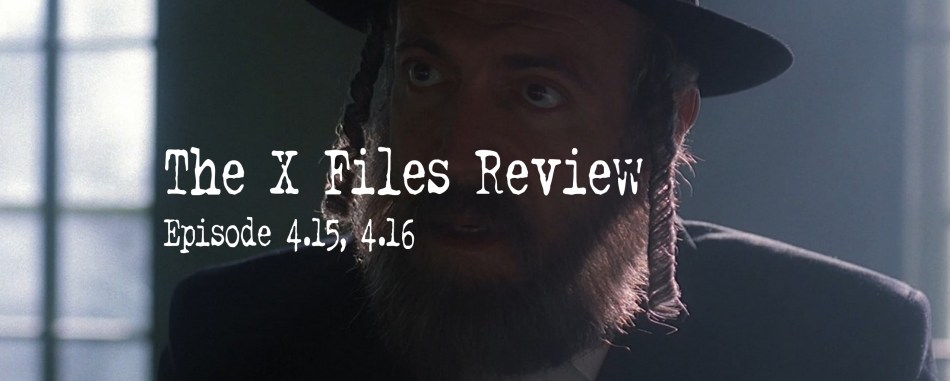
After the funeral of a man named Isaac who was killed by a group of neo-nazis, an unknown dark figure enters the cemetery near his grave and constructs a man-shaped sculpture out of mud. When one of the Isaac’s assailants turns up dead with his fingerprints on the new victim’s neck, Mulder and Sully are brought in to investigate. Skeptical Scully believes the evidence is staged and the murder is an act of retribution. Mulder believes otherwise and they visit a nearby store owned by a known racist who knew Isaac. Mulder warns the owner that he and two others who work for him are in danger since its rumored they were responsible for Isaac’s death.
When these neo-nazis dig up Isaac’s grave and find his body intact, they themselves become victims of brutal murders. The agents then find a book buried with Isaac, a Sefer Yetzirah, but it mysteriously bursts into flames. They believe Isaac’s father is responsible and find him in a synagogue with the last remaining neo-nazi who has been hanged. Jacob takes responsibility, but video footage from the store shows the golem that looks like Isaac. Mulder deduces that Ariel, Isaac’s fiancé, created the golem out of loneliness because she wasn’t able to marry Isaac. Both Mulder and Jacob fight with the creature, but it is Ariel’s declaration of love for the real Isaac that returns the golem to dust.
Watching this episode now, I am not sure why I have zero recollection of it. This macabre backwards take on Romeo and Juliet is something I would probably remember. It also has one of the more memorable soundtracks as series composer Mark Snow used violin and cello solos to set the tone. The themes of playing God to resurrect your loved one by carving them out of mud also plays into themes from Mary Shelley’s Frankenstein. The main difference is that Ariel’s flaw was loving Isaac so much she wanted a soulless golem in his place because she couldn’t let him go as opposed to Victor Frankenstein’s ego in creating a monster he could not control. The social commentary about how even non-violent racism of other cultures are just as guilty as those that do physical harm speaks loudly in this episode.
Honestly, I’m a bit miffed at myself for not remembering this one. It’s a hard thing to take inspiration from Shakespear, Mary Shelley, and Jewish folklore and make an episode about grief come across in such an emotional way.
Unrequited
Writer Howard Gordon and series creator Chris Carter wrote the episode Unrequited after seeing an episode of 60 Minutes where the CIA left behind American agents in the Vietnam War. Gordon’s brother is an ophthalmologist, which is where the concept of the antagonist creating blind spots in people’s vision allowing for his escape came into play.
Long story short, this episode follows the FBI as they chase a man responsible for the deaths of several military personal. He keeps eluding capture because he keeps disappearing from their sight. Eventually, Mulder figures out that no one can see him if they are in his line of sight and he is eventually taken down but not before giving Skinner a non-mortal gunshot wound. The Pentagon intentionally gives a false name to the assailant, which Mulder calls out as a lie. Skinner is left at the Vietnam War Memorial contemplating his own service in the war.
I think I barely remember this episode because it’s borderline unwatchable. It really isn’t an X-File so much as an FBI procedural episode about apprehending an assailant. There is little character development aside from the blunt reminder that Skinner was in the Vietnam war. Since the show was filmed in Vancouver, the producers had to find locations in Canada that looked like Washington, but the war memorial itself is a recreation. It also falls short of giving Vietnam War vets the recognition they deserve which was one of the intended themes.
I’m reminded of the show True Detective, which I finally got around to watching in 2024, for multiple reasons. That show took inspiration from shows like The X-Files and included some supernatural aspects to the investigations, especially the second half of season 1 and season 4. Season 4 of True Detective also explored the darker sides of grief and isolation much in the same way that Kaddish does. They have a similar folk horror feeling without actually being folk horror. Lastly, I find season three of True Detective to be unwatchable despite its great cast, so it shares that similarity with Unrequited. They both stand out for how bad they are.
Until next week, the truth is out there.
Discover more from Becky Tyler Art and Photography
Subscribe to get the latest posts sent to your email.


 Becky Tyler Art and Photography
I’ve rewatched The X-Files half a dozen times, the last being in 2021 before this current rewatch. With the first five seasons, I have rewatched certain episodes in syndication more times than I can count because my teen and college years allowed for more time in front of the television and that was the height of the popularity of the show. These episodes stick with me much more than others, but I usually remember small parts from the episodes I haven’t seen as many times. Turns out, there are two episodes in season 4 that I have little to no recollection of. Usually with bad episodes, I remember them for what they lack. With good ones, I simply remember what made them good. One of these two is great while the other is mid at best, so I have no idea why I blocked them out. Perhaps it is because they largely ignore Scully’s cancer diagnosis and treatment. Perhaps I simply wasn’t paying too much attention. I’m paying attention now.
Kaddish
Jewish folklore features an anthropomorphic figure created from inanimate matter such as mud or clay called a golem. It can be either gender or even both, either victim or villain, and is used in stories about community, isolation, hope, and despair. Essentially, it can mean many things at once depending on the story. In the bible, it refers to an uncompleted human before God’s eyes, meaning they are unsophisticated. In Hebrew, the word golem means helpless or dumb. A metaphor for a stupid man.
Howard Gordon, who is Jewish, wrote this episode because he wanted to an episode inspired by the golem mythology. The communal ring featured in the episode is a real Jewish relic used at a ceremony Gordon had attended. It inspired him to write a story about the desire to bring a loved one back from the dead, but the episode also deals with themes of antisemitism. The title itself, Kaddish, is a hymn praising God recited during prayer services.
After the funeral of a man named Isaac who was killed by a group of neo-nazis, an unknown dark figure enters the cemetery near his grave and constructs a man-shaped sculpture out of mud. When one of the Isaac’s assailants turns up dead with his fingerprints on the new victim’s neck, Mulder and Sully are brought in to investigate. Skeptical Scully believes the evidence is staged and the murder is an act of retribution. Mulder believes otherwise and they visit a nearby store owned by a known racist who knew Isaac. Mulder warns the owner that he and two others who work for him are in danger since its rumored they were responsible for Isaac’s death.
When these neo-nazis dig up Isaac’s grave and find his body intact, they themselves become victims of brutal murders. The agents then find a book buried with Isaac, a Sefer Yetzirah, but it mysteriously bursts into flames. They believe Isaac’s father is responsible and find him in a synagogue with the last remaining neo-nazi who has been hanged. Jacob takes responsibility, but video footage from the store shows the golem that looks like Isaac. Mulder deduces that Ariel, Isaac’s fiancé, created the golem out of loneliness because she wasn’t able to marry Isaac. Both Mulder and Jacob fight with the creature, but it is Ariel’s declaration of love for the real Isaac that returns the golem to dust.
Watching this episode now, I am not sure why I have zero recollection of it. This macabre backwards take on Romeo and Juliet is something I would probably remember. It also has one of the more memorable soundtracks as series composer Mark Snow used violin and cello solos to set the tone. The themes of playing God to resurrect your loved one by carving them out of mud also plays into themes from Mary Shelley’s Frankenstein. The main difference is that Ariel’s flaw was loving Isaac so much she wanted a soulless golem in his place because she couldn’t let him go as opposed to Victor Frankenstein’s ego in creating a monster he could not control. The social commentary about how even non-violent racism of other cultures are just as guilty as those that do physical harm speaks loudly in this episode.
Honestly, I’m a bit miffed at myself for not remembering this one. It’s a hard thing to take inspiration from Shakespear, Mary Shelley, and Jewish folklore and make an episode about grief come across in such an emotional way.
Unrequited
Writer Howard Gordon and series creator Chris Carter wrote the episode Unrequited after seeing an episode of 60 Minutes where the CIA left behind American agents in the Vietnam War. Gordon’s brother is an ophthalmologist, which is where the concept of the antagonist creating blind spots in people’s vision allowing for his escape came into play.
Long story short, this episode follows the FBI as they chase a man responsible for the deaths of several military personal. He keeps eluding capture because he keeps disappearing from their sight. Eventually, Mulder figures out that no one can see him if they are in his line of sight and he is eventually taken down but not before giving Skinner a non-mortal gunshot wound. The Pentagon intentionally gives a false name to the assailant, which Mulder calls out as a lie. Skinner is left at the Vietnam War Memorial contemplating his own service in the war.
I think I barely remember this episode because it’s borderline unwatchable. It really isn’t an X-File so much as an FBI procedural episode about apprehending an assailant. There is little character development aside from the blunt reminder that Skinner was in the Vietnam war. Since the show was filmed in Vancouver, the producers had to find locations in Canada that looked like Washington, but the war memorial itself is a recreation. It also falls short of giving Vietnam War vets the recognition they deserve which was one of the intended themes.
I’m reminded of the show True Detective, which I finally got around to watching in 2024, for multiple reasons. That show took inspiration from shows like The X-Files and included some supernatural aspects to the investigations, especially the second half of season 1 and season 4. Season 4 of True Detective also explored the darker sides of grief and isolation much in the same way that Kaddish does. They have a similar folk horror feeling without actually being folk horror. Lastly, I find season three of True Detective to be unwatchable despite its great cast, so it shares that similarity with Unrequited. They both stand out for how bad they are.
Until next week, the truth is out there.
Discover more from Becky Tyler Art and Photography
Subscribe to get the latest posts sent to your email.
Share this: