During this, the final installment of my series on yellow in horror movies, I’ll be discussing how the color is used in the setting of some films. These places help set the stage for how the characters will struggle or die. Sometimes, evil is a place. Sometimes, the setting of a film is just as memorable as the story or the characters. Sometimes, the filmmakers make something so brightly yellow that it lives rent free in my head. Yes, Ari Aster. I’m talking about you.
Midsommar
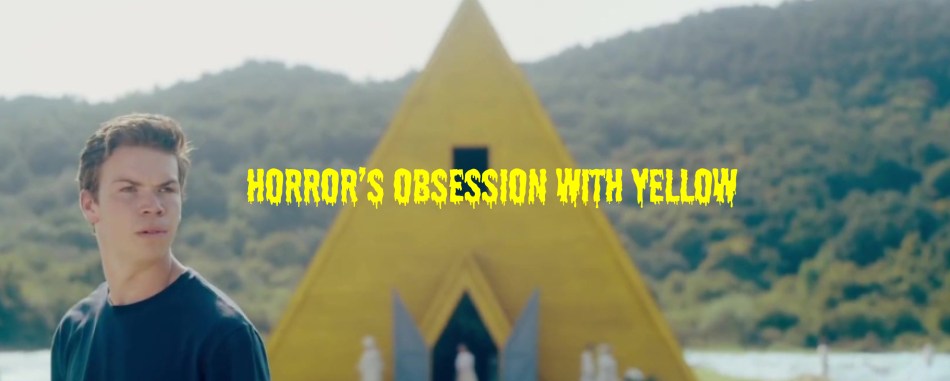
Ari Aster created an A-frame style building for the cult in his film to burn down at the end as a sacrifice to whatever gods they worship. And he painted it yellow. Bright almost neon yellow. The color repeats throughout the film from the flowers that the newcomers walk through to get to the commune, to the herbs used in the tea that made everyone high. The film itself is intentionally over exposed giving a glaring, sometimes sickly yellow tint to the proceedings. But that yellow building was the most memorable especially when Aster filled it with the carcasses of the people who had been killed off screen and the drugged living body of a grieving lonely woman’s boyfriend in a bear suit. This horrifying, beautiful film about loneliness and grief is one I watch often. I sometimes refer to it as Swedish Wicker Man. Anyhoo, that yellow building was a beacon of hope for a people who wanted their crops to grow and prosper and for a brokenhearted woman who never felt accepted by her own partner. With that, it was also a warning to those who visited and died had they only paid closer attention to the art around the commune. The clues were right there, but sometimes paying attention is too expensive when you are young.
House of Wax (2005)
At the height of Elisha Cuthbert’s career when 24 was the best show on television and The Girl Next Door had turned her into a sex symbol, she churned out a remake of a Vincent Price classic. As the title suggests, there is a house made out of wax along with everything within. And it’s yellow. The bodies within were made using real living humans as molds. The two men creating this macabre museum have deeply rooted mental issues stemming from childhood trauma so creating a museum with such a sickly color is telling. They also have Whatever Happened to Baby Jane playing in their movie theater full of wax bodies. The film is about the mental decline of a character with issues stemming from childhood. It’s not an accident the filmmakers chose that film to play in that scene. Innocence lost thrown right in our faces.
When Cuthbert and Chad Michael Murray have to escape the museum as it melts in a fire, they have to dig their way out of oozing, dripping hot yellow wax. This is probably the clearest metaphor for mental rot and decay to appear on my blog this spooky season.
A Cure for Wellness
In A Cure for Wellness, the building used for the exteriors of the wellness retreat is a light shade of yellow. Hohenzollern Castle in Germany has and almost ivory stone and brick walls that create a labyrinth of pathways in and out of the castle, but with a sickly undertone to it that symbolizes the illness within both the building and the people staying there. The entire movie is about the internal rot of the characters that populate it, so setting it in such a building is a really beautiful way of subtly getting that point across. Also used for the grounds and garden shots during filming was Beelitz-Heilstätten Hospital which had been used as a tuberculosis hospital in the past. Its gardens were used for external shots. Sometimes it’s hard to find just the right place to film your entire film, but it does occasionally happen…
Session 9
In the 1800s, it was common to design psychiatric hospitals like old gothic manors with long staggered structures meant to allow fresh air and light to provide a welcoming environment for patients to recover. The hospitals were meant to be entirely self sufficient so they included full kitchens, round the clock staff, a water tower, and their own cemeteries. Thomas Story Kirkbride is credited as the person who came up with the idea. Now, most of these buildings are too big to maintain and are partially or fully closed. The one I’m talking about today was featured in director Brad Anderson’s 2001 film Session 9.
Danvers State Hospital in Danvers, Massachusetts was designed by architect Nathaniel Jeremiah Bradlee and opened in 1878. It closed permanently in 1992 and was mostly demolished in 2007 despite being on the National Registry of Historic Places. In the film, a hazmat crew are hired to clean up the structure which, after its closure, became water damaged. Asbestos in ceiling tiles needed to be removed.
The first shot of the film is a wheelchair sitting forlornly in a hallway doused in shadow and peeling paint. Yellow light filters in through a doorway from an adjacent window onto the wheelchair and dirty floor making the place look ill and rotted. The interior of the building is covered in pale yellow tiles and peeling ivory or yellow lead paint. Pastel pink often highlights these other colors in what was supposed to be a calming color scheme. Now it looks as if the walls themselves are ill.
One of the characters, when flipping on electricity, is lured into an adjacent room when yellow light makes him realize there are more rooms around him. What he finds are old patient records and an evidence box containing recordings of one patient’s sessions about why she stabbed her brother. She was diagnosed with multiple personality disorder. I bet you can guess how many sessions were recorded.
By the time this guy gets to session 9, one of the hazmat crew have gone missing and another gets trapped in a dark tunnel as the lights go out. The owner of the company that operates the hazmat crew has descended into paranoia and anger over how the project is going. The psychological aspects of this film are so well done that by the time the film ends, you’re left with one line said by an entity who feeds on our worst fears. I live in the weak and the wounded, it states menacingly as an aerial shot of the hospital ends the film. The obvious undertones of the yellow interior and lighting are the mental rot and decay in each of these characters. The weak and the wounded.
The Shining & Doctor Sleep
While Stanley Kubrick’s adaptation of Stephen King’s book didn’t quite understand the material, Kubrick did manage to make his interpretation one of the best horror movies of the 1980s, if not all time.
The Overlook Hotel exteriors were filmed at the Timberline Lodge in Oregon, and most of the interiors were filmed on sound stages in England, including the lobby and room 237. What you see in the movie was inspired by the Ahwahnee Hotel in Yosemite National Park. The yellow curtains and furniture. The Native American floor designs that featured ivories, tans, and oranges. The yellow door and trim that entered into their caretaker apartment. The yellow walls and trim within. Even their yellow bedding where Jack and Wendy slept. Lest we forget that yellow hallway where Danny saw those twins hacked to bits and the yellow floor and trim in the green bathroom of room 237. It was all the perfect color scheme for Jack Torrence to slowly descend into drunken, paranoid madness while he tries to write and take care of the hotel. All work and no play make Jack a dull boy.
The golden ballroom was a thing of beauty. Opulence for the visitors who, by Ullman’s own admission, were rich and famous. He neglected to tell them about all the deaths within the hotel, so that sickly golden yellow ballroom was the perfect place for Jack to discover he can procure alcoholic beverages from the spirits haunting the hotel. His already battered mind had no defense as the moral decay settled in.
Where Kubrick’s interpretation deviated, Mike Flanagan’s adaptation of the sequel, Doctor Sleep, course corrected. It gave us an imperfect Danny as an adult who returned to the place of his childhood trauma to save Abra from some baddies who shined darkly. This place is sick, Abra stated the moment she set foot in the Overlook. Water damaged. Rotted. Pealing lead paint. An asylum of the dead.
Enter Rose the Hat played marvelously by Rebecca Ferguson. She wears a dark yellow coat. Tan if you’re looking in normal light. But in tainted Overlook light, that coat is the color of illness. Rot. Decay. Everything Rose the Hat is under the pretty exterior.
Flanagan took us to all the old Overlook haunts. Room 237. The Gold Room. The old apartment. Danny could lock the place away all he wanted, but it was still there rotting away. Even when the spirits invade Danny’s mind, Abra never stops believing in him. This faith brings Danny back just long enough to do what his father couldn’t. Let the boiler explode.
These two movies together make a hell of a movie night. Pun intended. Because that is what the Overlook was to Danny. To Wendy. And to Jack even if Kubrick’s version denied him the redemption of blowing up the Overlook to save Danny and Wendy. That redemption now is Danny’s so he can save Abra. And it all started in one yellow Voltswagon.
Yellow vehicles often appear in horror films and symbolize the decay and internal rot of the characters within them. In The Shining, Kubrick used a yellow Voltswagon Beetle. The car was described as red in the book, but Kubrick thought yellow enhanced the unsettling feel of his film. Jack Nicholson’s character was already imperfect and struggling when they made that trip, so the yellow shows his internal decay before they even arrived at the hotel as a family.
I’ll leave you this year with this thought at the end of Spooky Season. When I thought of doing this blog series over the summer, I really started paying close attention to how color was utilized in horror films. It has given me new found love for these films, especially the ones I have watched a dozen times or more. May I suggest that you do the same? You’ll find new beauty in the things that you love.
Until next year, horror fans. Happy haunting and beware of yellow.
Discover more from Becky Tyler Art and Photography
Subscribe to get the latest posts sent to your email.

 Becky Tyler Art and Photography
Chapter 13
Happy Halloween, my horror loving friends.
During this, the final installment of my series on yellow in horror movies, I’ll be discussing how the color is used in the setting of some films. These places help set the stage for how the characters will struggle or die. Sometimes, evil is a place. Sometimes, the setting of a film is just as memorable as the story or the characters. Sometimes, the filmmakers make something so brightly yellow that it lives rent free in my head. Yes, Ari Aster. I’m talking about you.
Midsommar
Ari Aster created an A-frame style building for the cult in his film to burn down at the end as a sacrifice to whatever gods they worship. And he painted it yellow. Bright almost neon yellow. The color repeats throughout the film from the flowers that the newcomers walk through to get to the commune, to the herbs used in the tea that made everyone high. The film itself is intentionally over exposed giving a glaring, sometimes sickly yellow tint to the proceedings. But that yellow building was the most memorable especially when Aster filled it with the carcasses of the people who had been killed off screen and the drugged living body of a grieving lonely woman’s boyfriend in a bear suit. This horrifying, beautiful film about loneliness and grief is one I watch often. I sometimes refer to it as Swedish Wicker Man. Anyhoo, that yellow building was a beacon of hope for a people who wanted their crops to grow and prosper and for a brokenhearted woman who never felt accepted by her own partner. With that, it was also a warning to those who visited and died had they only paid closer attention to the art around the commune. The clues were right there, but sometimes paying attention is too expensive when you are young.
House of Wax (2005)
At the height of Elisha Cuthbert’s career when 24 was the best show on television and The Girl Next Door had turned her into a sex symbol, she churned out a remake of a Vincent Price classic. As the title suggests, there is a house made out of wax along with everything within. And it’s yellow. The bodies within were made using real living humans as molds. The two men creating this macabre museum have deeply rooted mental issues stemming from childhood trauma so creating a museum with such a sickly color is telling. They also have Whatever Happened to Baby Jane playing in their movie theater full of wax bodies. The film is about the mental decline of a character with issues stemming from childhood. It’s not an accident the filmmakers chose that film to play in that scene. Innocence lost thrown right in our faces.
When Cuthbert and Chad Michael Murray have to escape the museum as it melts in a fire, they have to dig their way out of oozing, dripping hot yellow wax. This is probably the clearest metaphor for mental rot and decay to appear on my blog this spooky season.
A Cure for Wellness
In A Cure for Wellness, the building used for the exteriors of the wellness retreat is a light shade of yellow. Hohenzollern Castle in Germany has and almost ivory stone and brick walls that create a labyrinth of pathways in and out of the castle, but with a sickly undertone to it that symbolizes the illness within both the building and the people staying there. The entire movie is about the internal rot of the characters that populate it, so setting it in such a building is a really beautiful way of subtly getting that point across. Also used for the grounds and garden shots during filming was Beelitz-Heilstätten Hospital which had been used as a tuberculosis hospital in the past. Its gardens were used for external shots. Sometimes it’s hard to find just the right place to film your entire film, but it does occasionally happen…
Session 9
In the 1800s, it was common to design psychiatric hospitals like old gothic manors with long staggered structures meant to allow fresh air and light to provide a welcoming environment for patients to recover. The hospitals were meant to be entirely self sufficient so they included full kitchens, round the clock staff, a water tower, and their own cemeteries. Thomas Story Kirkbride is credited as the person who came up with the idea. Now, most of these buildings are too big to maintain and are partially or fully closed. The one I’m talking about today was featured in director Brad Anderson’s 2001 film Session 9.
Danvers State Hospital in Danvers, Massachusetts was designed by architect Nathaniel Jeremiah Bradlee and opened in 1878. It closed permanently in 1992 and was mostly demolished in 2007 despite being on the National Registry of Historic Places. In the film, a hazmat crew are hired to clean up the structure which, after its closure, became water damaged. Asbestos in ceiling tiles needed to be removed.
The first shot of the film is a wheelchair sitting forlornly in a hallway doused in shadow and peeling paint. Yellow light filters in through a doorway from an adjacent window onto the wheelchair and dirty floor making the place look ill and rotted. The interior of the building is covered in pale yellow tiles and peeling ivory or yellow lead paint. Pastel pink often highlights these other colors in what was supposed to be a calming color scheme. Now it looks as if the walls themselves are ill.
One of the characters, when flipping on electricity, is lured into an adjacent room when yellow light makes him realize there are more rooms around him. What he finds are old patient records and an evidence box containing recordings of one patient’s sessions about why she stabbed her brother. She was diagnosed with multiple personality disorder. I bet you can guess how many sessions were recorded.
By the time this guy gets to session 9, one of the hazmat crew have gone missing and another gets trapped in a dark tunnel as the lights go out. The owner of the company that operates the hazmat crew has descended into paranoia and anger over how the project is going. The psychological aspects of this film are so well done that by the time the film ends, you’re left with one line said by an entity who feeds on our worst fears. I live in the weak and the wounded, it states menacingly as an aerial shot of the hospital ends the film. The obvious undertones of the yellow interior and lighting are the mental rot and decay in each of these characters. The weak and the wounded.
The Shining & Doctor Sleep
While Stanley Kubrick’s adaptation of Stephen King’s book didn’t quite understand the material, Kubrick did manage to make his interpretation one of the best horror movies of the 1980s, if not all time.
The Overlook Hotel exteriors were filmed at the Timberline Lodge in Oregon, and most of the interiors were filmed on sound stages in England, including the lobby and room 237. What you see in the movie was inspired by the Ahwahnee Hotel in Yosemite National Park. The yellow curtains and furniture. The Native American floor designs that featured ivories, tans, and oranges. The yellow door and trim that entered into their caretaker apartment. The yellow walls and trim within. Even their yellow bedding where Jack and Wendy slept. Lest we forget that yellow hallway where Danny saw those twins hacked to bits and the yellow floor and trim in the green bathroom of room 237. It was all the perfect color scheme for Jack Torrence to slowly descend into drunken, paranoid madness while he tries to write and take care of the hotel. All work and no play make Jack a dull boy.
The golden ballroom was a thing of beauty. Opulence for the visitors who, by Ullman’s own admission, were rich and famous. He neglected to tell them about all the deaths within the hotel, so that sickly golden yellow ballroom was the perfect place for Jack to discover he can procure alcoholic beverages from the spirits haunting the hotel. His already battered mind had no defense as the moral decay settled in.
Where Kubrick’s interpretation deviated, Mike Flanagan’s adaptation of the sequel, Doctor Sleep, course corrected. It gave us an imperfect Danny as an adult who returned to the place of his childhood trauma to save Abra from some baddies who shined darkly. This place is sick, Abra stated the moment she set foot in the Overlook. Water damaged. Rotted. Pealing lead paint. An asylum of the dead.
Enter Rose the Hat played marvelously by Rebecca Ferguson. She wears a dark yellow coat. Tan if you’re looking in normal light. But in tainted Overlook light, that coat is the color of illness. Rot. Decay. Everything Rose the Hat is under the pretty exterior.
Flanagan took us to all the old Overlook haunts. Room 237. The Gold Room. The old apartment. Danny could lock the place away all he wanted, but it was still there rotting away. Even when the spirits invade Danny’s mind, Abra never stops believing in him. This faith brings Danny back just long enough to do what his father couldn’t. Let the boiler explode.
These two movies together make a hell of a movie night. Pun intended. Because that is what the Overlook was to Danny. To Wendy. And to Jack even if Kubrick’s version denied him the redemption of blowing up the Overlook to save Danny and Wendy. That redemption now is Danny’s so he can save Abra. And it all started in one yellow Voltswagon.
Yellow vehicles often appear in horror films and symbolize the decay and internal rot of the characters within them. In The Shining, Kubrick used a yellow Voltswagon Beetle. The car was described as red in the book, but Kubrick thought yellow enhanced the unsettling feel of his film. Jack Nicholson’s character was already imperfect and struggling when they made that trip, so the yellow shows his internal decay before they even arrived at the hotel as a family.
I’ll leave you this year with this thought at the end of Spooky Season. When I thought of doing this blog series over the summer, I really started paying close attention to how color was utilized in horror films. It has given me new found love for these films, especially the ones I have watched a dozen times or more. May I suggest that you do the same? You’ll find new beauty in the things that you love.
Until next year, horror fans. Happy haunting and beware of yellow.
Discover more from Becky Tyler Art and Photography
Subscribe to get the latest posts sent to your email.
Share this: