Chapter 10
When I look back on my childhood in the 80s when MTV actually played music videos, I think of Michael Jackson’s Thriller video. It was like a movie, only short. A musical with horror elements. In my teens, I remember seeing some documentary about the contacts Jackson wore to make his eyes yellow. They were thick painful ones that likely left his eyes sore for hours if not days after removing them. The eyes matched the red and yellow letterman’s jacket he wore in the beginning of the video and contrasted the leather one he danced in later. Like a lot of horror imagery, yellow is often used in contrast with red. The two colors pop off each other, a feast for the eyes.
In this, the tenth installment of my Yellow in Horror series, I’m discussing the use of yellow in eyes as a way to convey different versions of evil. Like in Thriller, not all of these movies have a happy ending and the evil remains. Lurking behind those eyes. Insert Vincent Price’s evil laughing here.
Transformation of the Werewolf
The first time I watched An American Werewolf in London, what struck me was how great the transformation effects are. For 1981, the effects are stellar. Above and beyond anything released at the time. They still hold up today. David’s eyes turn yellow and his body begins the painful switch from man to beast. There was no turning back. Not even falling in love with his hot nurse with Van Gogh’s Sunflowers watching over him from the wall of his hospital room could stop it.
When David and Jack strolled into The Slaughtered Lamb with its yellow sign at the beginning of the film, I knew something terrible would happen. The sign itself was a warning to stay away. Inside, everyone wore sickly shades of green. Wax the color of puss had dripped and dried under pillar candles like an infection gone wrong. The locals sent the two men on their way knowing they would be run afoul by a werewolf. They were too late trying to save them later. As I said, this film remains one of the best examples of a werewolf in modern times, and not just for the transformation effects. As a whole, this film stands above so many others.
Jack Nicholson starred in the 1994 film Wolf. The film is more about how the slow transformation into a wolf improved his senses to a point where he sniffed out his wife’s affair with his coworker and he could suddenly read without his glasses. The transformation had its downsides, however. It made him insatiably hungry during the night, which is a dangerous thing to happen when you live in NYC. His eyes, too, turn yellow when he does begin physically transforming into the wolf. Once he sniffs out the affair his wife was having with his coworker, he bites the coworker, a rather manipulative James Spader. Spader’s character also begins to turn and kills the wife to frame the main protagonist. This film is just as much about how who you are as a human affects who you become as a werewolf. Spader’s version has far more sinister things on his mind showing he was always more monster than man. At the end of the film, Michelle Pfiffer’s character walks toward the camera, her eyes now glowing yellow and gold. She, too, will become the wolf.
In 2002’s Dog Soldiers, the yellow eyes signify the full transformation from human to wolf in its full lupine form. Ravenous. Savage. Pure predator. Something that soldiers expect to come in contact with in war but not in the wilds of Scotland.
The Unscrupulous Nature of the Vampire
Stephanie Meyer wrote the Twilight series with the color of the vampire’s eyes in mind. In her novels, gold or yellow eyes indicate that the vampire feeds on animal blood. Red eyes indicate feeding on humans. Black eyes mean that the vampire is hungry, ravenously so. And you should probably run if you are warm blooded. While Twilight is not my favorite example of the use of color in vampire lore, it does give us something different when you compare these novels and their film adaptations to vampire movies that dive deeper into the realm of horror.
In the first adaptation of Stephen King’s Salem’s Lot, yellow eyes were a way of showing just how terrifying a vampire Kurt Barlow was. The pointed teeth and the greyed skin made the yellow eyes all the more unsettling as the main antagonist. Each person who was turned also woke with the yellow eyes. How horrifying a thing to see your loved one wake up a blood sucking monster.
Most people remember Chris Sarandon from The Princess Bride or Child’s Play or as the voice of Jack Skellington. My first Chris Sarandon movie was Fright Night. Here, the yellow eyes were utilized whenever the vampire was about to feed. Whenever their hunger was insatiable or, in the case of Sarandon’s Jerry Dandrige, whenever they were at their most evil.
In the vampire film Daybreakers, vampirism is an actual plague. Something that has infected the human race and the race to either find a cure or find a synthetic solution to feeding on human blood is quickly becoming a losing matter. Vampirism is noted by a person’s eyes which are golden, almost yellow, along this the development of fangs and the loss of a heartbeat. The film’s bleak tone and use of dark blues and grays highlight how the golden hue of these vampires makes them feel otherworldly. Something that should not exist on Earth except for the plague that wrought it.
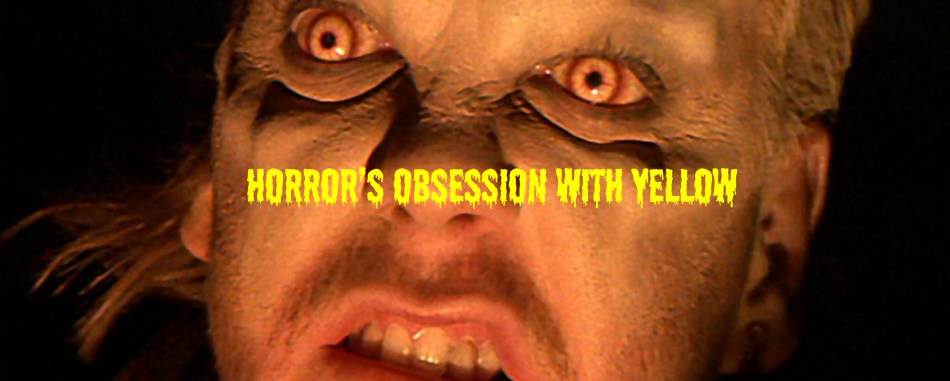
And then there’s Kiefer Sutherland and his band of bad boy vampires in The Lost Boys. The classic also starring Corey Felfman and Corey Haim is so steeped in 1980s culture that just saying that both Coreys are in it sends the viewer right into that era. When this gang of evil Peter Pan pretenders transition into vampires to feed, their eyes burn yellow and the teeth grow long. It was safe to assume that Kiefer was the head vampire until, SURPRISE, he was just the ringleader of his little gang. Edward Herrman was the head vampire, and he had come to collect his boys a mother. All is fair when it comes to love and vampires, right?
The Demonic
In Ira Levin’s Rosemary’s Baby, he wrote that the infant in question had yellow eyes. No iris, just a black slit for a pupil and bright yellow surrounding it. The eyes of Satan. While we never see this in Polanski’s adaptation, we do see Rosemary’s reaction to them brought to life by Mia Farrow. She is all of us seeing the horror she carried within herself. Had loved and named and planned for. Rosemary, for all her naivety, could only watch on in horror.
In the Evil Dead films, when a person is possessed with a deadite (a demonic spirit associated with the franchise) they often have yellow, bloodshot eyes. It’s a sickly color, one of rot or puss or decay. This intentional makeup effect is meant to show the internal rotting of the soul as the demonic spirit takes hold and makes the person do terrible things to themselves and to others. Most recently in Evil Dead Rise, the mother character continually harasses and demeans her own children after the demon possesses her. Mommy’s with the maggots now, after all.
The Little Pale Girl demon is what possesses the body of Vicky Reyes in Terrifier 2 and 3. These films thrive on gore, on the spillage of so much blood that red often feels like the main focus of the films as far as color goes. It is Vicky’s glowing yellow eyes that caught my attention in the third film for her body somehow survived for five years whilst Art the Clown remained dormant. She awakened when he did, so whatever demon or evil spirit that inhabits her must be something truly powerful and terrifying indeed. Art’s eyes do not glow yellow ever, so I have to ask the question on a lot of people’s minds. Is Vicky possessed by Satan himself? If so, why her and not Art the Clown? Is Art the puppet of Vicky if she is possessed by Satan? If so, why not sooner in the series? Will Terrifier 4 answer these questions? We can only hope, though I must say that the answers to these questions are not a necessity to enjoying the hell out of the films themselves if gratuitous gore is your thing.
In general, yellow in the eyes of villains or antagonists in horror films denote something evil is at play. It does not need to be all out Art the Clown kill mode. The subtly in which the vampire in Interview With a Vampire is flawed whilst still trying to be decent can denote more of a rotting guilt in his core that comes through in his golden eyes. This aligns with some of Stephanie Meyer’s lore about feeding on animals gives you golden eyes instead of red ones. Vampirism as a plague, an illness, in Daybreakers also shows the internal struggles with feeding on humans for food much in the way that Jack Nicholson’s wolf was far less evil than the man who tried to take his job and slept with his wife who took being turning into a wolf to a much darker place. Rosemary was horrified by the yellow of her baby’s eyes but still found a way to be its mother in the end. Yellow in these films can mean many things if we only choose to look into the abyss to find the meaning.
Discover more from Becky Tyler Art and Photography
Subscribe to get the latest posts sent to your email.

 Becky Tyler Art and Photography
Chapter 10
When I look back on my childhood in the 80s when MTV actually played music videos, I think of Michael Jackson’s Thriller video. It was like a movie, only short. A musical with horror elements. In my teens, I remember seeing some documentary about the contacts Jackson wore to make his eyes yellow. They were thick painful ones that likely left his eyes sore for hours if not days after removing them. The eyes matched the red and yellow letterman’s jacket he wore in the beginning of the video and contrasted the leather one he danced in later. Like a lot of horror imagery, yellow is often used in contrast with red. The two colors pop off each other, a feast for the eyes.
In this, the tenth installment of my Yellow in Horror series, I’m discussing the use of yellow in eyes as a way to convey different versions of evil. Like in Thriller, not all of these movies have a happy ending and the evil remains. Lurking behind those eyes. Insert Vincent Price’s evil laughing here.
Transformation of the Werewolf
The first time I watched An American Werewolf in London, what struck me was how great the transformation effects are. For 1981, the effects are stellar. Above and beyond anything released at the time. They still hold up today. David’s eyes turn yellow and his body begins the painful switch from man to beast. There was no turning back. Not even falling in love with his hot nurse with Van Gogh’s Sunflowers watching over him from the wall of his hospital room could stop it.
When David and Jack strolled into The Slaughtered Lamb with its yellow sign at the beginning of the film, I knew something terrible would happen. The sign itself was a warning to stay away. Inside, everyone wore sickly shades of green. Wax the color of puss had dripped and dried under pillar candles like an infection gone wrong. The locals sent the two men on their way knowing they would be run afoul by a werewolf. They were too late trying to save them later. As I said, this film remains one of the best examples of a werewolf in modern times, and not just for the transformation effects. As a whole, this film stands above so many others.
Jack Nicholson starred in the 1994 film Wolf. The film is more about how the slow transformation into a wolf improved his senses to a point where he sniffed out his wife’s affair with his coworker and he could suddenly read without his glasses. The transformation had its downsides, however. It made him insatiably hungry during the night, which is a dangerous thing to happen when you live in NYC. His eyes, too, turn yellow when he does begin physically transforming into the wolf. Once he sniffs out the affair his wife was having with his coworker, he bites the coworker, a rather manipulative James Spader. Spader’s character also begins to turn and kills the wife to frame the main protagonist. This film is just as much about how who you are as a human affects who you become as a werewolf. Spader’s version has far more sinister things on his mind showing he was always more monster than man. At the end of the film, Michelle Pfiffer’s character walks toward the camera, her eyes now glowing yellow and gold. She, too, will become the wolf.
In 2002’s Dog Soldiers, the yellow eyes signify the full transformation from human to wolf in its full lupine form. Ravenous. Savage. Pure predator. Something that soldiers expect to come in contact with in war but not in the wilds of Scotland.
The Unscrupulous Nature of the Vampire
Stephanie Meyer wrote the Twilight series with the color of the vampire’s eyes in mind. In her novels, gold or yellow eyes indicate that the vampire feeds on animal blood. Red eyes indicate feeding on humans. Black eyes mean that the vampire is hungry, ravenously so. And you should probably run if you are warm blooded. While Twilight is not my favorite example of the use of color in vampire lore, it does give us something different when you compare these novels and their film adaptations to vampire movies that dive deeper into the realm of horror.
In the first adaptation of Stephen King’s Salem’s Lot, yellow eyes were a way of showing just how terrifying a vampire Kurt Barlow was. The pointed teeth and the greyed skin made the yellow eyes all the more unsettling as the main antagonist. Each person who was turned also woke with the yellow eyes. How horrifying a thing to see your loved one wake up a blood sucking monster.
Most people remember Chris Sarandon from The Princess Bride or Child’s Play or as the voice of Jack Skellington. My first Chris Sarandon movie was Fright Night. Here, the yellow eyes were utilized whenever the vampire was about to feed. Whenever their hunger was insatiable or, in the case of Sarandon’s Jerry Dandrige, whenever they were at their most evil.
In the vampire film Daybreakers, vampirism is an actual plague. Something that has infected the human race and the race to either find a cure or find a synthetic solution to feeding on human blood is quickly becoming a losing matter. Vampirism is noted by a person’s eyes which are golden, almost yellow, along this the development of fangs and the loss of a heartbeat. The film’s bleak tone and use of dark blues and grays highlight how the golden hue of these vampires makes them feel otherworldly. Something that should not exist on Earth except for the plague that wrought it.
And then there’s Kiefer Sutherland and his band of bad boy vampires in The Lost Boys. The classic also starring Corey Felfman and Corey Haim is so steeped in 1980s culture that just saying that both Coreys are in it sends the viewer right into that era. When this gang of evil Peter Pan pretenders transition into vampires to feed, their eyes burn yellow and the teeth grow long. It was safe to assume that Kiefer was the head vampire until, SURPRISE, he was just the ringleader of his little gang. Edward Herrman was the head vampire, and he had come to collect his boys a mother. All is fair when it comes to love and vampires, right?
The Demonic
In Ira Levin’s Rosemary’s Baby, he wrote that the infant in question had yellow eyes. No iris, just a black slit for a pupil and bright yellow surrounding it. The eyes of Satan. While we never see this in Polanski’s adaptation, we do see Rosemary’s reaction to them brought to life by Mia Farrow. She is all of us seeing the horror she carried within herself. Had loved and named and planned for. Rosemary, for all her naivety, could only watch on in horror.
In the Evil Dead films, when a person is possessed with a deadite (a demonic spirit associated with the franchise) they often have yellow, bloodshot eyes. It’s a sickly color, one of rot or puss or decay. This intentional makeup effect is meant to show the internal rotting of the soul as the demonic spirit takes hold and makes the person do terrible things to themselves and to others. Most recently in Evil Dead Rise, the mother character continually harasses and demeans her own children after the demon possesses her. Mommy’s with the maggots now, after all.
The Little Pale Girl demon is what possesses the body of Vicky Reyes in Terrifier 2 and 3. These films thrive on gore, on the spillage of so much blood that red often feels like the main focus of the films as far as color goes. It is Vicky’s glowing yellow eyes that caught my attention in the third film for her body somehow survived for five years whilst Art the Clown remained dormant. She awakened when he did, so whatever demon or evil spirit that inhabits her must be something truly powerful and terrifying indeed. Art’s eyes do not glow yellow ever, so I have to ask the question on a lot of people’s minds. Is Vicky possessed by Satan himself? If so, why her and not Art the Clown? Is Art the puppet of Vicky if she is possessed by Satan? If so, why not sooner in the series? Will Terrifier 4 answer these questions? We can only hope, though I must say that the answers to these questions are not a necessity to enjoying the hell out of the films themselves if gratuitous gore is your thing.
In general, yellow in the eyes of villains or antagonists in horror films denote something evil is at play. It does not need to be all out Art the Clown kill mode. The subtly in which the vampire in Interview With a Vampire is flawed whilst still trying to be decent can denote more of a rotting guilt in his core that comes through in his golden eyes. This aligns with some of Stephanie Meyer’s lore about feeding on animals gives you golden eyes instead of red ones. Vampirism as a plague, an illness, in Daybreakers also shows the internal struggles with feeding on humans for food much in the way that Jack Nicholson’s wolf was far less evil than the man who tried to take his job and slept with his wife who took being turning into a wolf to a much darker place. Rosemary was horrified by the yellow of her baby’s eyes but still found a way to be its mother in the end. Yellow in these films can mean many things if we only choose to look into the abyss to find the meaning.
Discover more from Becky Tyler Art and Photography
Subscribe to get the latest posts sent to your email.
Share this: