Chapter 8
Rewatching 28 Years Later once it landed on Netflix was a revelation. When I watched it in theaters, I had only begun to think about how yellow was used in horror. Months later, after having immersed myself in the horror genre seeking out how yellow was used, I could watch this with new eyes.
I first noticed yellow during my rewatch right away when we see the room full of kids watching The Teletubbies. Those creepy dancing figures in brightly colored costumes that populated children’s programming channels when the first film was released. This seemed random at the time, but by the end of the film, those children watching that show right when the infected starting attacking people only caused them to grow up into a bizarre group of pandemic Power Rangers. The next film is going to be epic.
Anyway, the real first great use of yellow in the film is when we first meet Isla (Jodie Comer) in her bedroom – or should I say sickroom? For what the room is used for and how ill and feverish Isla looks, the ivory-almost-yellow walls scream illness. Even her sheets and pillowcase are yellow. Under normal circumstances, it would be a calming, comforting place to sleep. But these aren’t normal circumstances and Isla is a very sick mother and wife. The colors in that room are more ominous than anything.
Later, when Spike and his father, Jamie, return from their jaunt onto the mainland, they are thrown into a party of adult proportions. Spike, only a kid, is not ready for it and the yellowish light from the candles and lanterns makes the room feel overly warm and chaotic to both the viewer and to Spike. He over indulges and ends up outside puking. Again, yellow feels like an illness especially when Spike sees his father cheating on his sick mother.
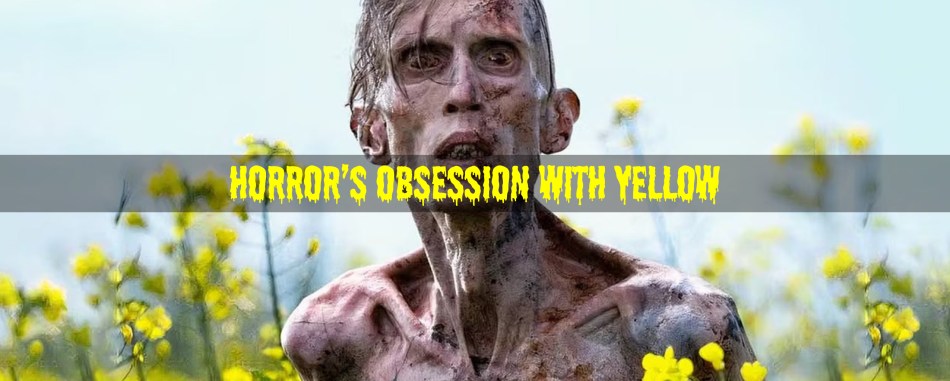
Once Spike takes Isla off the island in search of a doctor, they end up walking through a field of yellow wildflowers. This beautiful landscape is accented by one of Isla’s memories of Jamie bringing her to that very place to see a statue. She seems happy with the memory, her illness bothers her less for a moment or two. Then, an emaciated man infected with the rage virus rises from the flowers near them. Spike realizes the infected have found them and they go on the run. There is a little bit of innocence lost in that scene with the yellow flowers as Spike begins to realize how broken his family is. Fear settles in as he realizes little by little he might not be able to save his mother.
Spike and Isla try to take refuge in an old Shell gas station as the infected give chase. It is bright yellow and stands out even as the woods have tried to overtake the old building. WARNING those yellow walls scream. Do not enter here. Inside, benzene has become trapped and hiding in there was a mistake. The infected follow them and they all begin to suffocate. If it wasn’t for the soldier, Erik saving them, they would have died in that room.
Later, they come across an abandoned yellow train that is as much overtaken by nature as the Shell gas station. It looks sturdy enough to find some shelter in, but just like the Shell gas station, the yellow color feels like more of a warning. The lighting in the train is off-putting because green moss and mold has grown over the windows. They hear someone in pain and find a pregnant infected woman trying to give birth. Isla shows empathy for her and helps her birth her baby. Once delivered the infected woman passes out and Spike and Isla notice that her baby isn’t infected. It’s a normal healthy baby. Their reverie is broken when the infected woman wakes up screaming and Erik panics. He shoots and kills her only to be killed himself by the Alpha chasing them.
In the theater, that was the scene that I knew the film was something special. A moment of true humanity followed by terror and death. The train was a momentary sanctuary and now it becomes a death trap as Spike and Isla try to find a way to survive the Alpha’s rage. What happens in that train mimics our society. One minute we support each other and the next we are at war and the fight for survival is exhausting.
Once outside the train, Spike, Isla, and the baby are saved by Dr. Kelson (Ralph Fiennes) who drugs the alpha. Kelson’s shirt is yellowed and stained and his skin is dirty with an red-orange-yellowish tint. This man looks dangerous, but he is the most kind and generous character in the film. The sickly color of his shirt is more an allegory for the world as a whole than it is for him. The world, or at least the mainland of Scotland, is infected. Dr. Kelson is just doing his best to survive it and inject some good into it.
While the ending veers into another narrative, this film as a whole shows the best of humanity and a little of the worst. Its use of yellow varies depending on the scene, from loss of innocence to moral decay to internal rot. That rot can either be the infected or the cancer killing Isla. Moral decay in the violence that persists in our society, infected or not, because the infection just brings out the violent primal nature in all of us and strips away our humanity. The loss of innocence and the illusion of safety tend to go hand in hand. How fragile our civilization is even without the complexities of the post-apocalyptic world.
I can’t wait for the sequel and how it carries on with these themes. I’ll be seated opening weekend. Will you? Until my next blog, stay out of abandoned Shell stations, yeah?
Discover more from Becky Tyler Art and Photography
Subscribe to get the latest posts sent to your email.


 Becky Tyler Art and Photography
Chapter 8
Rewatching 28 Years Later once it landed on Netflix was a revelation. When I watched it in theaters, I had only begun to think about how yellow was used in horror. Months later, after having immersed myself in the horror genre seeking out how yellow was used, I could watch this with new eyes.
I first noticed yellow during my rewatch right away when we see the room full of kids watching The Teletubbies. Those creepy dancing figures in brightly colored costumes that populated children’s programming channels when the first film was released. This seemed random at the time, but by the end of the film, those children watching that show right when the infected starting attacking people only caused them to grow up into a bizarre group of pandemic Power Rangers. The next film is going to be epic.
Anyway, the real first great use of yellow in the film is when we first meet Isla (Jodie Comer) in her bedroom – or should I say sickroom? For what the room is used for and how ill and feverish Isla looks, the ivory-almost-yellow walls scream illness. Even her sheets and pillowcase are yellow. Under normal circumstances, it would be a calming, comforting place to sleep. But these aren’t normal circumstances and Isla is a very sick mother and wife. The colors in that room are more ominous than anything.
Later, when Spike and his father, Jamie, return from their jaunt onto the mainland, they are thrown into a party of adult proportions. Spike, only a kid, is not ready for it and the yellowish light from the candles and lanterns makes the room feel overly warm and chaotic to both the viewer and to Spike. He over indulges and ends up outside puking. Again, yellow feels like an illness especially when Spike sees his father cheating on his sick mother.
Once Spike takes Isla off the island in search of a doctor, they end up walking through a field of yellow wildflowers. This beautiful landscape is accented by one of Isla’s memories of Jamie bringing her to that very place to see a statue. She seems happy with the memory, her illness bothers her less for a moment or two. Then, an emaciated man infected with the rage virus rises from the flowers near them. Spike realizes the infected have found them and they go on the run. There is a little bit of innocence lost in that scene with the yellow flowers as Spike begins to realize how broken his family is. Fear settles in as he realizes little by little he might not be able to save his mother.
Spike and Isla try to take refuge in an old Shell gas station as the infected give chase. It is bright yellow and stands out even as the woods have tried to overtake the old building. WARNING those yellow walls scream. Do not enter here. Inside, benzene has become trapped and hiding in there was a mistake. The infected follow them and they all begin to suffocate. If it wasn’t for the soldier, Erik saving them, they would have died in that room.
Later, they come across an abandoned yellow train that is as much overtaken by nature as the Shell gas station. It looks sturdy enough to find some shelter in, but just like the Shell gas station, the yellow color feels like more of a warning. The lighting in the train is off-putting because green moss and mold has grown over the windows. They hear someone in pain and find a pregnant infected woman trying to give birth. Isla shows empathy for her and helps her birth her baby. Once delivered the infected woman passes out and Spike and Isla notice that her baby isn’t infected. It’s a normal healthy baby. Their reverie is broken when the infected woman wakes up screaming and Erik panics. He shoots and kills her only to be killed himself by the Alpha chasing them.
In the theater, that was the scene that I knew the film was something special. A moment of true humanity followed by terror and death. The train was a momentary sanctuary and now it becomes a death trap as Spike and Isla try to find a way to survive the Alpha’s rage. What happens in that train mimics our society. One minute we support each other and the next we are at war and the fight for survival is exhausting.
Once outside the train, Spike, Isla, and the baby are saved by Dr. Kelson (Ralph Fiennes) who drugs the alpha. Kelson’s shirt is yellowed and stained and his skin is dirty with an red-orange-yellowish tint. This man looks dangerous, but he is the most kind and generous character in the film. The sickly color of his shirt is more an allegory for the world as a whole than it is for him. The world, or at least the mainland of Scotland, is infected. Dr. Kelson is just doing his best to survive it and inject some good into it.
While the ending veers into another narrative, this film as a whole shows the best of humanity and a little of the worst. Its use of yellow varies depending on the scene, from loss of innocence to moral decay to internal rot. That rot can either be the infected or the cancer killing Isla. Moral decay in the violence that persists in our society, infected or not, because the infection just brings out the violent primal nature in all of us and strips away our humanity. The loss of innocence and the illusion of safety tend to go hand in hand. How fragile our civilization is even without the complexities of the post-apocalyptic world.
I can’t wait for the sequel and how it carries on with these themes. I’ll be seated opening weekend. Will you? Until my next blog, stay out of abandoned Shell stations, yeah?
Discover more from Becky Tyler Art and Photography
Subscribe to get the latest posts sent to your email.
Share this: