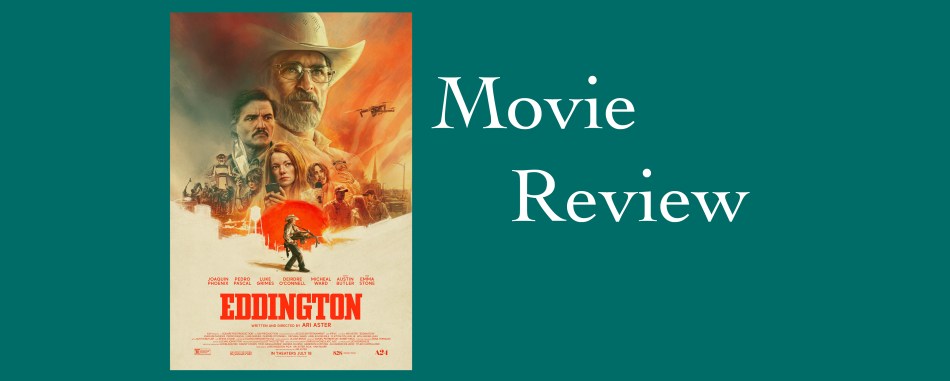
When I heard Ari Aster was making a Covid film, I wondered how he could possibly make 2020 any more horrifying than it already was given his past films (Midsommar, Hereditary). His intention with Eddington was not a horror movie. In fact, it’s more of a commentary on the times we live in. That doesn’t make it any less horrifying given the context. If you have seen his third film about having an existential crisis, Beau is Afraid, you know what I’m talking about.
Eddington is a small town in New Mexico that is next to an Indian Reservation. It is May of 2020 and Covid has not made anyone sick here yet. A homeless man, obviously mentally and physically ill, walks into town from lord knows where.
Sheriff Joe Cross (Joaquin Phoenix) struggles with the new mask mandate and does not want to enforce it. Mayor Ted Garcia (Pedro Pascal) wants the rules followed. When Ted’s bar is attacked by a sick homeless man, Joe doesn’t want to intervene but does only to be accosted and coughed on by the homeless man. As his town begins to descend into Covid chaos, Joe decides to run for mayor against Ted.
As Joe’s week goes on and he begins to show Covid symptoms, his town is on edge. Half the townspeople don’t want a data farm build nearby, and the people on the Reservation really don’t want it built. George Floyd has been killed in Minneapolis. Protests are erupting. Joe’s wife is leaving him for a guy who is internet famous for his outlandish views when she realizes that Joe posted a video on social media saying that the Mayor had raped her when she was sixteen. The Mayor didn’t, but the rumors persist in large part thanks to fake news spread by her mother.
There is really no way to review this without giving away the ending, so if you don’t want it spoiled, skip ahead three paragraphs.
Joe, having been humiliated by his wife leaving and Ted Garcia slapping him publicly, he descends further into madness lined with Covid and kills Ted Garcia in his home and tries to frame the protesters. More specifically, he wants to blame Antifa. While his own department believes his narrative, the officer from the Indian Reservation does not. He knows Joe had something to do with it.
Also on the police force in Eddington is a black officer, Michael (Michael Ward). He is the middle ground in this film, neither a protester nor someone who wants anyone harmed. He would just like for things to calm down even as the protesters get in his face about being a black officer. When Joe tries to frame him as part of this Antifa plot, Michael can hardly come to terms with it.
Turns out, there were actual terrorists in Eddington who were there specifically to sow hatred and enflame the situation. And they did their job so well Joe ends up in a gun fight with them. He barely survives only because a kid with a gun saves him at the last second and films it for social media clout because of course he did. Joe does indeed become Mayor, but he is severely handicapped and his mother-in-law is calling the shots politically. The data farm gets built. Eddington may be peaceful again, but the hate still circulates online.
Eddington is shocking in its ability to capture the events of that summer with so much clarity and even manages a few moments of humor in the ridiculousness of it all. Ari Aster never once uses the words democrat or republican or even Donald Trump. He never refers to anyone as the left or the right. He simply lets these characters’ actions playing out on screen speak for themselves. He uses social media and the internet to enflame the situation as false information proliferates online. How easy it was to go down that rabbit hole and believe all the things that you want to hear. How quickly we lost our ability to find middle ground while we yelled at each other about race and vaccines and masks.
And the kid who saves the sheriff at the end? He doesn’t step in when he sees the other shooter coming. He waits until the shooter has wounded Joe horrifically before making himself known. He filmed it because it was not about saving the sheriff’s life. It was about his forwarding his own agenda about guns as he is later seen with Marjorie Taylor Greene on a social media montage.
This film shows the lengths people will go to to prove their point regardless of who gets in their way. It doesn’t shy away from how politicians and the people in charge aren’t bringing us together. They are tearing us apart. It makes you question the information we are given because if we don’t question it, isn’t it just propaganda?
Aster also uses Covid as an allegory for how so many people descended into anger and hatred during that summer. After Joe is exposed, he unknowingly spread it to the people around him while he was asymptomatic in a town where there wasn’t one confirmed case of Covid. He refused to mask up because he had asthma even if the mask would have lessoned his chances of getting a respiratory virus to begin with and would have kept him from spreading it to so many people. Once symptoms were present, he was well on his way to creating chaos. As his inhaler runs out and he can barely breathe, he shooting machine guns at masked terrorists.
And you know what? Ari Aster isn’t wrong here. Things really did descend into anarchy much in the way that Covid symptoms present to a point where we could hardly breathe let alone talk to each other with respect. If that isn’t a commentary on our times, then I don’t know what is.
Joaquin Phoenix and Pedro Pascal turn in great performances here. Phoenix in particular will probably be remembered for his take with this character. The supporting cast including Emma Stone, Austin Butler, and Deidre O’Connell all show up at their best, though Stone and Butler have limited parts.
4.5 out of 5 stars for having the audacity to call our society out on how terrible our behavior is sometimes.
Discover more from Becky Tyler Art and Photography
Subscribe to get the latest posts sent to your email.


 Becky Tyler Art and Photography
When I heard Ari Aster was making a Covid film, I wondered how he could possibly make 2020 any more horrifying than it already was given his past films (Midsommar, Hereditary). His intention with Eddington was not a horror movie. In fact, it’s more of a commentary on the times we live in. That doesn’t make it any less horrifying given the context. If you have seen his third film about having an existential crisis, Beau is Afraid, you know what I’m talking about.
Eddington is a small town in New Mexico that is next to an Indian Reservation. It is May of 2020 and Covid has not made anyone sick here yet. A homeless man, obviously mentally and physically ill, walks into town from lord knows where.
Sheriff Joe Cross (Joaquin Phoenix) struggles with the new mask mandate and does not want to enforce it. Mayor Ted Garcia (Pedro Pascal) wants the rules followed. When Ted’s bar is attacked by a sick homeless man, Joe doesn’t want to intervene but does only to be accosted and coughed on by the homeless man. As his town begins to descend into Covid chaos, Joe decides to run for mayor against Ted.
As Joe’s week goes on and he begins to show Covid symptoms, his town is on edge. Half the townspeople don’t want a data farm build nearby, and the people on the Reservation really don’t want it built. George Floyd has been killed in Minneapolis. Protests are erupting. Joe’s wife is leaving him for a guy who is internet famous for his outlandish views when she realizes that Joe posted a video on social media saying that the Mayor had raped her when she was sixteen. The Mayor didn’t, but the rumors persist in large part thanks to fake news spread by her mother.
There is really no way to review this without giving away the ending, so if you don’t want it spoiled, skip ahead three paragraphs.
Joe, having been humiliated by his wife leaving and Ted Garcia slapping him publicly, he descends further into madness lined with Covid and kills Ted Garcia in his home and tries to frame the protesters. More specifically, he wants to blame Antifa. While his own department believes his narrative, the officer from the Indian Reservation does not. He knows Joe had something to do with it.
Also on the police force in Eddington is a black officer, Michael (Michael Ward). He is the middle ground in this film, neither a protester nor someone who wants anyone harmed. He would just like for things to calm down even as the protesters get in his face about being a black officer. When Joe tries to frame him as part of this Antifa plot, Michael can hardly come to terms with it.
Turns out, there were actual terrorists in Eddington who were there specifically to sow hatred and enflame the situation. And they did their job so well Joe ends up in a gun fight with them. He barely survives only because a kid with a gun saves him at the last second and films it for social media clout because of course he did. Joe does indeed become Mayor, but he is severely handicapped and his mother-in-law is calling the shots politically. The data farm gets built. Eddington may be peaceful again, but the hate still circulates online.
Eddington is shocking in its ability to capture the events of that summer with so much clarity and even manages a few moments of humor in the ridiculousness of it all. Ari Aster never once uses the words democrat or republican or even Donald Trump. He never refers to anyone as the left or the right. He simply lets these characters’ actions playing out on screen speak for themselves. He uses social media and the internet to enflame the situation as false information proliferates online. How easy it was to go down that rabbit hole and believe all the things that you want to hear. How quickly we lost our ability to find middle ground while we yelled at each other about race and vaccines and masks.
And the kid who saves the sheriff at the end? He doesn’t step in when he sees the other shooter coming. He waits until the shooter has wounded Joe horrifically before making himself known. He filmed it because it was not about saving the sheriff’s life. It was about his forwarding his own agenda about guns as he is later seen with Marjorie Taylor Greene on a social media montage.
This film shows the lengths people will go to to prove their point regardless of who gets in their way. It doesn’t shy away from how politicians and the people in charge aren’t bringing us together. They are tearing us apart. It makes you question the information we are given because if we don’t question it, isn’t it just propaganda?
Aster also uses Covid as an allegory for how so many people descended into anger and hatred during that summer. After Joe is exposed, he unknowingly spread it to the people around him while he was asymptomatic in a town where there wasn’t one confirmed case of Covid. He refused to mask up because he had asthma even if the mask would have lessoned his chances of getting a respiratory virus to begin with and would have kept him from spreading it to so many people. Once symptoms were present, he was well on his way to creating chaos. As his inhaler runs out and he can barely breathe, he shooting machine guns at masked terrorists.
And you know what? Ari Aster isn’t wrong here. Things really did descend into anarchy much in the way that Covid symptoms present to a point where we could hardly breathe let alone talk to each other with respect. If that isn’t a commentary on our times, then I don’t know what is.
Joaquin Phoenix and Pedro Pascal turn in great performances here. Phoenix in particular will probably be remembered for his take with this character. The supporting cast including Emma Stone, Austin Butler, and Deidre O’Connell all show up at their best, though Stone and Butler have limited parts.
4.5 out of 5 stars for having the audacity to call our society out on how terrible our behavior is sometimes.
Discover more from Becky Tyler Art and Photography
Subscribe to get the latest posts sent to your email.
Share this: