This morning’s episodes remind me how much The X-Files could both thrill me and disappoint me depending on the episode. And then there is always the gratuitous use of the phrase, “You son of a bitch.” It was a common phrase within the show used mostly by Mulder whilst insulting someone, but it was also employed by Scully more than once. Perhaps it was a 90’s thing, though I don’t remember that being all that common during my teen years. Maybe it was just a phrase that Chris Carter liked to use when writing the episodes. Or, maybe I’m just noticing because I watched three episodes today and I remember Scully saying it last week.
Episode 1.14 – Gender Bender
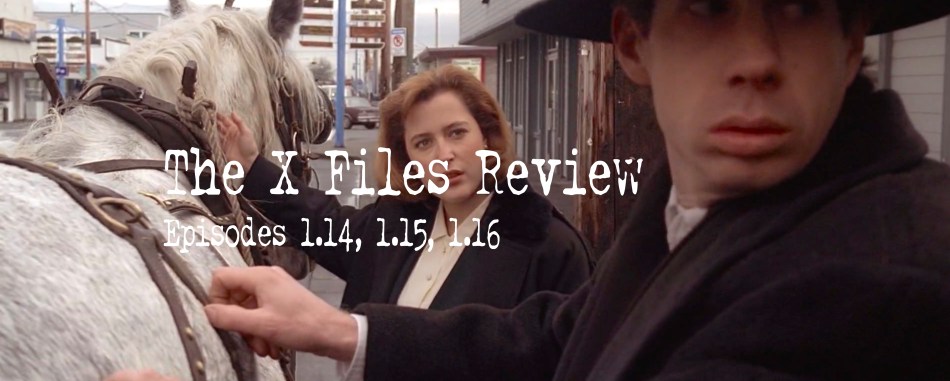
This episode was one of the more memorable ones for me because it explored the anxieties over changing gender roles and used the fear of sex or reproduction as the villain. Mulder and Scully investigate a serial killer who witnesses said was either man or woman. Victims ended up dead after they had sex with her/him. They track down the identity but it leads them to a reclusive Amish like colony who called themselves the Kindred. At the end of the episode, these people have disappeared, leaving a strange crop circle in a field leading Mulder to believe that they were either abducted or weren’t human to begin with.
During the summer of 1993, my parents moved our family to a small town that had a substantial Amish colony living on the outskirts of town. Their horse drawn buggy was a common fixture on Main Street and they operated a store that sold handmade furniture in town. Beyond that, they were pretty reclusive. Gender Bender, which aired in January of 1993, stood out for me because of my new surroundings. The Amish community held a special place of interest for me for many years, mainly because they did not like outsiders and they seemed to be repressed in just about every capacity. Fourteen-year-old me wanted a glimpse into their lives just so I could better understand it, though I never received one. Perhaps that is why this episode is always more memorable for me.
This was Glen Morgan’s directorial debut in the series, but he directed many more after and even directed the first film, Fight the Future. It also features actor Nicholas Lea who plays Michel, one of the victims. He later plays antagonist Alex Krycek in later seasons. The effects during which the killer shifts between male and female after each kill aren’t great, but they are believable for the time period.
Episode 1.15 – Lazarus
When the consciousness of a violent criminal is transferred to an FBI agent, it sends Mulder and Scully down a rabbit hole of what-the-hell-is-going-on-with-our-colleague. The episode itself is mid, neither great nor bad. It’s just there, bookended by a great and a bad episode.
When it was originally conceived, it was Mulder who was supposed to have his body possessed by the criminal, but producers did not want either Mulder nor Scully experiencing such an event personally. I have to agree. I would not have wanted to see Mulder suddenly become a violent villain at that point.
Episode 1.16 – Young at Heart
One of my least favorite episodes follows Mulder and Scully as a man from Mulder’s past comes back to kill him, only the man is younger. Scully’s medical background comes into play as she tries to disprove the man’s story about how using salamander cells to replace his hand caused him to age younger. Deep Throat confirms this, though this episode is not connected to the larger conspiracies at hand. AND – Mulder has a temper tantrum on the stand and openly calls the killer a son of a bitch in court. Like I said, popular phrase with Mulder.
This episode explores Mulder’s guilt from when he captured the man originally. Mulder neglected to shoot him because he had a hostage, and the man ended up killing the hostage and one other person before he was captured. By the end of this episode, Mulder does not make the same mistake twice.
Fringe Science
What I’m really reminded of after watching these three episodes today how much shows like Fringe took inspiration from The X-Files. I did not watch Fringe as obsessively as I did The X-Files during it original run, but have revisited it a few times since.
Fringe often explored some of these same themes – gender roles being reversed, possession of agents by other people, wild medical procedures with crazy side effects. I also like the parallels between Agent Scully and Anna Torv’s character, Olivia Dunham, in Fringe. Both characters were betrayed by either their government (Scully) or their partner (Dunham) and both had their convictions and beliefs tested time and time again by the people and circumstances around them.
Until next week, the truth is out there.
Discover more from Becky Tyler Art and Photography
Subscribe to get the latest posts sent to your email.


 Becky Tyler Art and Photography
This morning’s episodes remind me how much The X-Files could both thrill me and disappoint me depending on the episode. And then there is always the gratuitous use of the phrase, “You son of a bitch.” It was a common phrase within the show used mostly by Mulder whilst insulting someone, but it was also employed by Scully more than once. Perhaps it was a 90’s thing, though I don’t remember that being all that common during my teen years. Maybe it was just a phrase that Chris Carter liked to use when writing the episodes. Or, maybe I’m just noticing because I watched three episodes today and I remember Scully saying it last week.
Episode 1.14 – Gender Bender
This episode was one of the more memorable ones for me because it explored the anxieties over changing gender roles and used the fear of sex or reproduction as the villain. Mulder and Scully investigate a serial killer who witnesses said was either man or woman. Victims ended up dead after they had sex with her/him. They track down the identity but it leads them to a reclusive Amish like colony who called themselves the Kindred. At the end of the episode, these people have disappeared, leaving a strange crop circle in a field leading Mulder to believe that they were either abducted or weren’t human to begin with.
During the summer of 1993, my parents moved our family to a small town that had a substantial Amish colony living on the outskirts of town. Their horse drawn buggy was a common fixture on Main Street and they operated a store that sold handmade furniture in town. Beyond that, they were pretty reclusive. Gender Bender, which aired in January of 1993, stood out for me because of my new surroundings. The Amish community held a special place of interest for me for many years, mainly because they did not like outsiders and they seemed to be repressed in just about every capacity. Fourteen-year-old me wanted a glimpse into their lives just so I could better understand it, though I never received one. Perhaps that is why this episode is always more memorable for me.
This was Glen Morgan’s directorial debut in the series, but he directed many more after and even directed the first film, Fight the Future. It also features actor Nicholas Lea who plays Michel, one of the victims. He later plays antagonist Alex Krycek in later seasons. The effects during which the killer shifts between male and female after each kill aren’t great, but they are believable for the time period.
Episode 1.15 – Lazarus
When the consciousness of a violent criminal is transferred to an FBI agent, it sends Mulder and Scully down a rabbit hole of what-the-hell-is-going-on-with-our-colleague. The episode itself is mid, neither great nor bad. It’s just there, bookended by a great and a bad episode.
When it was originally conceived, it was Mulder who was supposed to have his body possessed by the criminal, but producers did not want either Mulder nor Scully experiencing such an event personally. I have to agree. I would not have wanted to see Mulder suddenly become a violent villain at that point.
Episode 1.16 – Young at Heart
One of my least favorite episodes follows Mulder and Scully as a man from Mulder’s past comes back to kill him, only the man is younger. Scully’s medical background comes into play as she tries to disprove the man’s story about how using salamander cells to replace his hand caused him to age younger. Deep Throat confirms this, though this episode is not connected to the larger conspiracies at hand. AND – Mulder has a temper tantrum on the stand and openly calls the killer a son of a bitch in court. Like I said, popular phrase with Mulder.
This episode explores Mulder’s guilt from when he captured the man originally. Mulder neglected to shoot him because he had a hostage, and the man ended up killing the hostage and one other person before he was captured. By the end of this episode, Mulder does not make the same mistake twice.
Fringe Science
What I’m really reminded of after watching these three episodes today how much shows like Fringe took inspiration from The X-Files. I did not watch Fringe as obsessively as I did The X-Files during it original run, but have revisited it a few times since.
Fringe often explored some of these same themes – gender roles being reversed, possession of agents by other people, wild medical procedures with crazy side effects. I also like the parallels between Agent Scully and Anna Torv’s character, Olivia Dunham, in Fringe. Both characters were betrayed by either their government (Scully) or their partner (Dunham) and both had their convictions and beliefs tested time and time again by the people and circumstances around them.
Until next week, the truth is out there.
Discover more from Becky Tyler Art and Photography
Subscribe to get the latest posts sent to your email.
Share this: